 1-800-537-2296
 sales@versitron.com



How 2-Channel Video to Fiber Installation Kits Power Secure Video Transmission Across Critical Sectors
2-Channel Video to Fiber Installation Kits
Many surveillance systems still rely on analog cameras that provide reliable performance but face a fundamental limitation: transmitting high-quality video over long distances using traditional copper cabling can become increasingly difficult.

As transmission distances increase, analog video signals may be affected by attenuation, electromagnetic interference (EMI), radio-frequency interference (RFI), and ground-loop problems. These challenges are particularly significant in large facilities and geographically distributed surveillance networks.
A 2-channel video-to-fiber installation kit provides a practical solution by allowing two analog video signals to be transmitted over fiber optic cable. Instead of replacing existing cameras or completely redesigning the surveillance system, organizations can use fiber to extend video connections between cameras and centralized monitoring or recording equipment.
Available configurations can also support additional communication requirements, including data and audio, making these kits suitable for a wide range of surveillance applications.
From transportation facilities and government campuses to industrial sites and commercial properties, 2-channel video-to-fiber installation kits provide a straightforward way to extend existing analog surveillance infrastructure while gaining the distance and interference-immunity advantages of fiber optic transmission.
What Is a 2-Channel Video-to-Fiber Installation Kit?
A 2-channel video-to-fiber installation kit is a complete transmission solution designed to carry two analog video signals over a fiber optic connection.
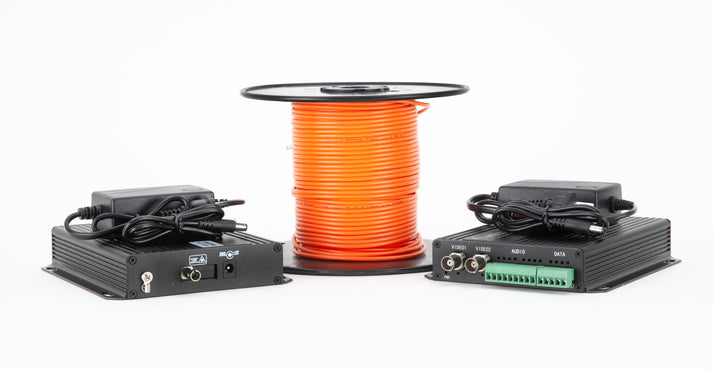
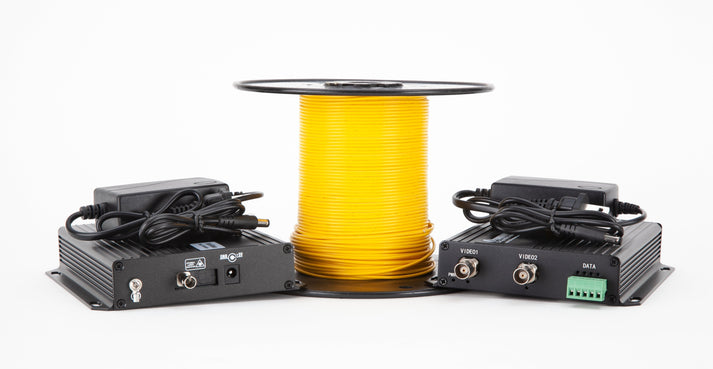
A typical kit includes:
- A 2-channel video transmitter
- A corresponding 2-channel video receiver
- Two power supplies
- A specified length of fiber optic cable
Depending on the selected configuration, kits are available for multimode or single-mode fiber and may also support data or audio transmission.
The basic operation is straightforward.
At the camera end, analog video signals are connected to the transmitter. The transmitter converts the incoming video signals into optical signals that can travel over fiber.
At the receiving end, the corresponding receiver converts the optical signals back into video signals for connection to compatible monitoring, switching, or recording equipment.
This transmitter-and-receiver architecture allows existing analog surveillance equipment to take advantage of fiber optic infrastructure without converting the entire surveillance system to an IP-based architecture.
Explore Our 2-Channel Digital Fiber Video Multiplexer Kits




Why Use Fiber for Analog Video Transmission?
Coaxial cable remains widely used in analog surveillance systems, but longer cable runs and electrically noisy environments can create significant challenges.
Fiber optic transmission addresses many of these limitations.
Longer Transmission DistancesOne of the primary reasons to use fiber is its ability to transport video over much greater distances than conventional copper-based video cabling.
Depending on the selected equipment and fiber configuration, VERSITRON 2-channel video-to-fiber solutions can support transmission distances of up to 30 kilometers.
This makes fiber useful for surveillance systems covering:
- Large campuses
- Transportation facilities
- Industrial sites
- Government facilities
- Utility infrastructure
- Parking areas
- Remote buildings
- Perimeter security networks
Instead of locating recording or monitoring equipment close to every camera, fiber allows video signals to be transported back to centralized locations across substantially greater distances.
Immunity to Electromagnetic and Radio-Frequency InterferenceFiber optic cable transmits information using light rather than electrical signals.
As a result, fiber is immune to electromagnetic and radio-frequency interference that can affect copper communication cables.
This can be especially valuable in environments containing:
- Motors and generators
- High-voltage equipment
- Industrial machinery
- Electrical substations
- Transportation infrastructure
- Radio transmission equipment
By moving the long-distance portion of the video connection onto fiber, organizations can maintain more consistent signal quality in environments where electrical interference could otherwise affect analog video transmission.
Electrical IsolationBecause fiber does not conduct electricity, it provides electrical isolation between the transmitting and receiving locations.
This can help eliminate problems associated with ground potential differences between separate buildings or remote equipment locations.
Electrical isolation is particularly useful when cameras and monitoring equipment are installed in different facilities or across geographically distributed infrastructure.
Consistent Video QualityThe 2-channel video-to-fiber systems described in these installation kits support uncompressed 8-bit digital transmission of analog video signals and compatibility with NTSC, PAL, and SECAM video formats.
By converting the incoming analog video for transmission across the fiber link, the system can transport the signal without the progressive degradation commonly associated with long analog copper cable runs.
The result is a practical method for maintaining consistent video quality between remote camera locations and centralized surveillance equipment.
Understanding the Available Kit Configurations
Not every surveillance installation requires the same combination of signals.
Some applications only need video transmission. Others require data communication for camera control, while certain installations may also require audio.
VERSITRON offers several 2-channel installation kit configurations to address these different requirements.
Video-Only KitsA video-only installation kit is designed for applications where the primary requirement is transporting two analog video signals between remote cameras and centralized surveillance equipment.
This is the simplest configuration and can be appropriate for fixed analog cameras that do not require remote control or additional communication channels.
Video-only configurations are available for both multimode and single-mode fiber.
Video and Data KitsSome surveillance applications require more than one-way video transmission.
Pan-Tilt-Zoom cameras, for example, may require a separate data connection to transmit control commands between the surveillance control system and the remote camera equipment.
Video-and-data configurations provide fiber transmission for the video signals while also supporting compatible data communications.
This allows the same fiber-based transmission system to support both camera video and control requirements.
When selecting a kit for a PTZ or other controlled device, the required data protocol should always be matched to the specifications of the selected equipment.
Video, Data, and Audio KitsFor applications requiring additional communication capabilities, video, data, and audio configurations provide a more comprehensive transmission solution.
These systems can be useful where surveillance infrastructure includes audio monitoring or communication equipment in addition to analog cameras and control data.
Selecting a kit that combines the required signal types can simplify installation by allowing multiple communications requirements to be supported through the fiber transmission system.
Single-Mode vs. Multimode Fiber
Choosing the correct fiber type is an important part of specifying a video-to-fiber installation kit.
Both multimode and single-mode fiber can be used for video transmission, but they are generally selected for different distance requirements and infrastructure environments.
Multimode FiberMultimode fiber is commonly used for shorter transmission distances within facilities, campuses, and other localized networks.
It may be the appropriate choice when multimode fiber is already installed or when the required transmission distance falls within the supported range of the selected equipment.
Typical applications can include:
- Building-to-building surveillance
- Industrial facilities
- Commercial campuses
- Parking facilities
- Local transportation infrastructure
Single-mode fiber is generally preferred for significantly longer transmission distances.
It is particularly useful when cameras are distributed across large geographic areas or when surveillance signals must travel between widely separated locations.
Applications may include:
- Highway surveillance
- Transportation systems
- Utility facilities
- Large government campuses
- Perimeter monitoring
- Remote security installations
The correct choice should be based on the transmission distance, existing fiber infrastructure, connector requirements, and specifications of the selected transmitter and receiver.
Supporting Existing Analog Surveillance Infrastructure
One of the most important advantages of a video-to-fiber installation kit is that organizations can extend the useful life and geographic reach of existing analog surveillance equipment.
Migrating an entire surveillance system from analog to IP can involve replacing cameras, recording equipment, network infrastructure, and associated cabling.
That may be appropriate for some modernization projects, but it is not always necessary simply because a camera needs to transmit video over a greater distance.
A video-to-fiber system allows organizations to continue using compatible analog cameras while introducing fiber where it provides the greatest benefit.
This approach can be particularly valuable for:
- Existing CCTV systems
- Infrastructure expansion projects
- Building-to-building connections
- Remote camera installations
- Legacy surveillance networks
- Phased system upgrades
Rather than treating analog and fiber technologies as mutually exclusive, a video-to-fiber installation kit creates a bridge between existing analog surveillance equipment and modern fiber optic transmission infrastructure.
Applications in Government and Public Infrastructure
Government facilities and public infrastructure often require surveillance systems that cover multiple buildings, large outdoor areas, and geographically distributed locations.
Two-channel video-to-fiber installation kits can provide an effective transmission solution when existing or newly deployed analog cameras must communicate with centralized monitoring facilities over extended distances.
Potential applications include:
- Municipal buildings
- Government campuses
- Public safety facilities
- Transportation infrastructure
- Parking facilities
- Perimeter surveillance
- Remote security checkpoints
- Public infrastructure monitoring
Fiber can be particularly beneficial when camera locations are separated from monitoring equipment by long distances or when the transmission path passes through areas with significant electrical interference.
The availability of video-only, video-and-data, and video-data-audio configurations also allows system designers to select a solution based on the actual requirements of the surveillance equipment rather than deploying unnecessary capabilities.
Transportation and Traffic Surveillance
Transportation infrastructure presents many of the conditions where fiber optic video transmission provides significant advantages.
Cameras may be located hundreds of meters or several kilometers from a central monitoring facility, while electrical equipment and other sources of interference can make copper transmission challenging.
Potential applications include:
- Highway monitoring
- Traffic surveillance
- Railway facilities
- Airports
- Ports
- Toll facilities
- Transit systems
- Traffic management infrastructure
For installations using controllable analog cameras, a video-and-data configuration can support video transmission along with compatible camera-control communications.
By transporting surveillance signals over fiber, transportation agencies and system integrators can connect remote camera locations to centralized monitoring infrastructure while avoiding many of the distance and interference limitations associated with copper cabling.
Industrial and Utility Applications
Industrial facilities and utility infrastructure often present challenging conditions for traditional copper-based video transmission. Large sites, electrical equipment, high-voltage systems, and geographically separated facilities can all complicate surveillance network design.
Two-channel video-to-fiber installation kits allow compatible analog cameras to communicate with centralized monitoring and recording equipment over fiber optic cable.
Potential applications include:
- Manufacturing facilities
- Utility substations
- Power generation facilities
- Water and wastewater treatment plants
- Oil and gas facilities
- Warehouses and distribution centers
- Renewable energy installations
- Industrial perimeter surveillance
Fiber's immunity to electromagnetic and radio-frequency interference makes it particularly useful around motors, generators, transformers, and other electrically noisy equipment.
For installations where cameras are located far from the control room, single-mode fiber can provide the transmission distance needed to centralize video monitoring without relying on long copper cable runs.
Where PTZ control or other compatible serial communications are required, a video-and-data installation kit can provide the appropriate combination of video and data transmission.
Commercial and Campus Surveillance
Large commercial properties often contain cameras distributed across multiple buildings, parking areas, entrances, and perimeter locations.
In these environments, fiber can provide an effective backbone for extending analog surveillance signals back to a centralized security location.
Typical applications include:
- Corporate campuses
- Educational institutions
- Healthcare facilities
- Hotels and resorts
- Shopping centers
- Office complexes
- Warehouses
- Multi-building properties
A two-channel installation kit can be particularly useful when a small number of remote cameras must be connected across a long distance.
For example, two cameras located at a remote entrance or parking facility could connect to a local transmitter. The video signals could then travel over fiber to a receiver located near the primary surveillance equipment.
This approach allows organizations to extend existing analog surveillance systems without installing separate long-distance copper connections for each camera.
PTZ Camera and Data Applications
Some of the most useful 2-channel video-to-fiber configurations are those that combine video transmission with data communication.
Pan-Tilt-Zoom cameras require control commands to travel from the operator or surveillance system back to the camera. Depending on the equipment being used, this communication may rely on serial data protocols such as RS-485.
A compatible video-and-data fiber kit can transport the camera video while also providing a path for control data.
A typical configuration may include:
At the remote location:
- Two analog surveillance cameras
- PTZ control equipment, if required
- Video-to-fiber transmitter
Across the transmission link:
- Multimode or single-mode fiber
At the monitoring location:
- Video-to-fiber receiver
- DVR, monitor, matrix switch, or other compatible video equipment
- PTZ controller or surveillance control system
The exact configuration depends on the cameras, control protocol, and selected installation kit.
System designers should always verify data compatibility before selecting a video-and-data model rather than assuming that every serial interface supports every camera-control system.
Video, Data, and Audio Applications
Some surveillance environments require audio communication or monitoring in addition to video and control data.
For these installations, a video, data, and audio fiber transmission kit can consolidate multiple signal requirements into one transmission solution.
Potential applications include:
- Security checkpoints
- Controlled entrances
- Remote monitoring stations
- Transportation facilities
- Industrial security locations
- Government facilities
The ability to transport multiple signal types can simplify infrastructure design, particularly when remote equipment must communicate with a centralized security or operations center.
As with data communications, the required audio and interface specifications should be verified against the selected equipment before installation.
How to Choose the Right 2-Channel Video-to-Fiber Kit
Selecting the appropriate installation kit requires more than simply determining that two video channels are needed.
The following factors should be considered:
| Requirement | Recommended Consideration |
|---|---|
| Two fixed analog cameras | Video-only kit |
| PTZ cameras or remote control requirements | Video-and-data kit |
| Video with control and audio requirements | Video, data, and audio kit |
| Shorter fiber transmission distances | Multimode configuration |
| Long-distance transmission | Single-mode configuration |
| Existing fiber infrastructure | Match the installed fiber type and connectors |
| Electrically noisy environment | Fiber provides immunity to EMI and RFI |
| Remote camera locations | Verify the required transmission distance |
Organizations should also verify:
- Video format compatibility
- Required data protocol
- Fiber connector type
- Available fiber strands
- Transmission distance
- Power availability at each endpoint
- Installation and mounting requirements
Matching these requirements before purchasing the equipment helps avoid compatibility problems during installation.
Installation Considerations
Although video-to-fiber installation kits are designed to simplify deployment, careful planning remains important.
Verify the Fiber TypeSingle-mode and multimode optical equipment are not interchangeable simply because the connectors appear similar.
The transmitter, receiver, and installed fiber should all be compatible.
Confirm the Optical DistanceSelect a system designed for the actual length of the fiber link. Longer transmission capability is generally associated with the appropriate single-mode equipment and optical specifications.
Check Video CompatibilityVerify that the cameras and receiving equipment use a video format supported by the selected transmission system.
Confirm Data RequirementsIf the application includes PTZ control or another serial data function, confirm that the selected kit supports the required interface.
Plan for Power at Both EndsThe transmitter and receiver require appropriate power. The installation should account for power availability at both equipment locations.
Protect Fiber ConnectionsFiber connectors should be kept clean and properly installed. Contamination or damaged connectors can introduce optical loss and affect system performance.
Addressing these considerations during system design can simplify installation and help ensure reliable long-term operation.
Why Choose a Complete Installation Kit?
A complete installation kit can simplify system specification by providing the primary components needed to establish the fiber transmission link.
Rather than sourcing the transmitter, receiver, power supplies, and initial fiber connection separately, the installer receives a matched solution designed to operate together.
This can provide several practical benefits:
- Simplified product selection
- Matched transmitter and receiver equipment
- Reduced compatibility concerns
- Faster installation planning
- Easier deployment for system integrators
- A straightforward path for extending existing analog surveillance systems
For organizations unfamiliar with fiber optic video transmission, a complete kit can also make the transition from copper-based video infrastructure easier to manage.
Why Choose VERSITRON?
VERSITRON has decades of experience providing fiber optic communication solutions for surveillance, government, industrial, commercial, and transportation applications.
VERSITRON 2-channel video-to-fiber installation kits provide complete solutions for extending compatible analog video signals over fiber, with configurations available to support different transmission and communication requirements.
Available options include:
- Two-channel analog video transmission
- Video-only configurations
- Video-and-data configurations
- Video, data, and audio configurations
- Multimode fiber options
- Single-mode fiber options
- Long-distance transmission configurations
- Compatibility with NTSC, PAL, and SECAM video formats
By offering multiple configurations, VERSITRON allows system integrators and network designers to select a solution based on the actual requirements of the surveillance application.
Conclusion
Two-channel video-to-fiber installation kits provide a practical solution for extending analog surveillance systems beyond the limitations of traditional copper cabling.
By transporting video over fiber optic infrastructure, organizations can achieve greater transmission distances while gaining immunity to electromagnetic and radio-frequency interference and electrical isolation between connected locations.
Different kit configurations allow system designers to support more than video alone. Where applications require camera control or additional communications, video-and-data and video-data-audio solutions provide options for integrating those signals into the fiber transmission system.
From transportation and government facilities to industrial sites, commercial campuses, and utility infrastructure, these systems allow organizations to extend compatible analog surveillance equipment without requiring a complete transition to IP-based video.
The key is selecting the appropriate configuration based on the number of video channels, required data and audio capabilities, fiber type, transmission distance, and existing infrastructure.
When properly specified, a 2-channel video-to-fiber installation kit provides a straightforward and reliable bridge between established analog surveillance technology and the long-distance transmission advantages of fiber optics.


