 1-800-537-2296
 sales@versitron.com



16-Channel Video to Fiber Installation Kits for Seamless, Scalable, and Secure Surveillance
16-Channel Video to Fiber Installation Kits
Large surveillance systems often require cameras to be installed across expansive facilities, multiple buildings, remote perimeters, and other locations far from centralized monitoring equipment. When numerous analog CCTV cameras are concentrated in one area, transporting each video signal individually over long copper cable runs can create significant infrastructure challenges.

A 16-channel video to fiber installation kit provides a practical solution by allowing up to sixteen compatible analog video signals to be transported between locations using fiber optic infrastructure.
These systems are particularly useful in higher-density surveillance environments where a large group of cameras must connect back to centralized recording or monitoring equipment. Depending on the configuration, systems may also provide a data communication path for compatible camera-control applications.
Available configurations include:
- 16-channel video with data over single-mode fiber
- 16-channel video with data over multimode fiber
- 16-channel video-only transmission over single-mode fiber
- 16-channel video-only transmission over multimode fiber
By matching the appropriate configuration to the existing surveillance architecture, fiber infrastructure, and transmission requirements, organizations can extend analog CCTV systems across significantly larger physical areas while gaining the inherent transmission advantages of fiber.
What Is a 16-Channel Video to Fiber Installation Kit?
A 16-channel video to fiber installation kit is designed to transport multiple compatible analog video signals across a fiber optic connection.
A typical system includes transmitting equipment at the camera side and corresponding receiving equipment at the monitoring location.
The basic architecture may look like this:
Up to 16 Analog Cameras → Video Transmitter → Fiber Optic Link → Video Receiver → DVR or Monitoring Equipment
The cameras connect to the transmission equipment using the appropriate local video cabling. The transmitter converts the incoming video signals for optical transmission across fiber.
At the opposite end of the link, the receiver converts the optical signals back into video outputs that can connect to compatible recording, monitoring, or distribution equipment.
The system does not convert analog cameras into IP cameras or create an Ethernet network. Instead, it provides a fiber optic transmission path for the supported analog video signals.
This makes 16-channel video-over-fiber equipment particularly relevant for organizations maintaining or extending larger existing analog CCTV systems.
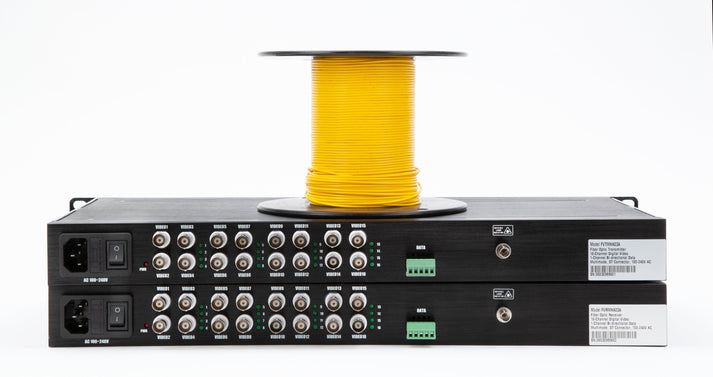
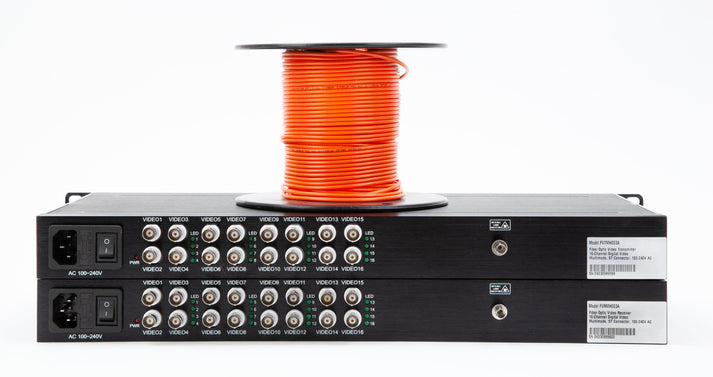
Explore Our 16-Channel Video to Fiber Installation Kits


Why Use a 16-Channel Fiber System?
The primary advantage of a 16-channel system is its ability to support a larger concentration of cameras through a consolidated transmission architecture.
Consider an industrial facility with sixteen cameras installed around a remote production area.
Without fiber transmission equipment, each camera might require a long individual copper video connection back to the central security room.
With a multi-channel fiber architecture, the cameras can connect locally to a 16-channel transmitter. The video signals are then carried across the fiber link to receiving equipment located closer to the centralized surveillance system.
A simplified architecture could look like this:
16 Remote Cameras → Local Video Connections → 16-Channel Fiber Transmitter → Fiber Backbone → Receiver → Central DVR
This approach can be particularly useful when cameras are geographically grouped but located a significant distance from the primary monitoring facility.
Where 16-Channel Systems Make the Most Sense
A 16-channel system is not necessarily the right solution for every surveillance installation.
If only one or two cameras are located at a remote site, a lower-channel-count system may provide a more appropriate solution.
A 16-channel system becomes particularly useful when:
- A large number of cameras are concentrated in one remote area
- Centralized video recording is required
- Long-distance copper transmission is impractical
- Existing fiber infrastructure is available
- Electromagnetic interference is a concern
- Cameras must communicate between separate buildings or facility zones
- An existing analog CCTV system needs to be extended rather than completely replaced
Potential applications include:
- Industrial facilities
- Manufacturing campuses
- Government installations
- Transportation facilities
- Utility infrastructure
- Large commercial properties
- Educational campuses
- Perimeter surveillance systems
The application itself does not determine whether a 16-channel system is appropriate. The most important factors are the number of cameras, their physical location, the existing surveillance technology, and the available fiber infrastructure.
Fiber for Long-Distance Analog CCTV Transmission
Traditional analog CCTV systems commonly use copper-based cabling between cameras and recording equipment.
As transmission distances increase, maintaining reliable video quality over copper can become more challenging.
Fiber optic transmission provides several important advantages for long-distance surveillance applications.
Greater Transmission DistanceFiber can support significantly longer transmission distances than conventional copper video cabling when used with compatible transmission equipment.
This can be useful when cameras are located:
- Across large campuses
- In remote buildings
- Along facility perimeters
- Throughout transportation infrastructure
- At utility facilities
- Across large industrial properties
The actual supported transmission distance depends on the specific equipment, fiber type, and complete optical path.
Immunity to Electromagnetic InterferenceFiber transmits signals using light rather than electrical current.
As a result, the fiber transmission path is immune to electromagnetic and radio-frequency interference.
This can be particularly valuable around:
- Industrial machinery
- Motors
- Generators
- High-voltage equipment
- Power infrastructure
- Electrically noisy environments
For surveillance systems operating across these environments, fiber can provide a more reliable long-distance transmission medium than copper.
Electrical IsolationFiber also provides electrical isolation between connected locations because there is no conductive electrical path through the fiber cable.
This can be beneficial when connecting surveillance equipment located in separate buildings or areas with different electrical grounding conditions.
Understanding the Four Main System Configurations
The 16-channel product family described in the original article includes four primary configurations:
16-Channel Video + Data, Single-ModeDesigned for applications requiring sixteen video channels, compatible data communication, and longer-distance transmission over single-mode fiber.
16-Channel Video + Data, MultimodeDesigned for applications requiring sixteen video channels and compatible data communication over multimode fiber.
16-Channel Video-Only, Single-ModeDesigned for long-distance applications where only the sixteen video signals need to cross the fiber link.
16-Channel Video-Only, MultimodeDesigned for shorter-distance multimode fiber installations where data communication is not required.
These configurations allow system designers to select equipment according to the actual requirements of the surveillance system rather than adding unnecessary capabilities.
Video-Only vs. Video-and-Data Systems
One of the first decisions when selecting a 16-channel video fiber system is whether the application requires a separate data communication path.
Video-Only SystemsA video-only configuration may be appropriate when all cameras are fixed and the only requirement is transporting their video signals to another location.
Potential applications include:
- Fixed perimeter cameras
- Building surveillance
- Industrial monitoring
- Parking facilities
- Facility security
- Existing analog CCTV systems
If no remote camera control or other supported data communication is required, a video-only system provides a straightforward transmission architecture.
Video Plus Data SystemsSome analog surveillance systems require a separate data connection between locations.
For example, compatible PTZ camera systems may use serial data communication for remote control.
In these applications, a video-plus-data system can provide both video transmission and a compatible data communication path across the fiber link.
Because the exact data interface can vary between products, system designers should verify:
- Supported data protocol
- Data direction
- Baud rate
- Camera requirements
- Controller compatibility
- Wiring configuration
The presence of a data channel does not automatically guarantee compatibility with every PTZ camera or control system.
Single-Mode vs. Multimode Fiber
The correct fiber type depends on the existing infrastructure and required transmission distance.
Multimode FiberMultimode fiber is commonly used for shorter fiber connections.
Potential applications include:
- Large buildings
- Industrial facilities
- Campus environments
- Equipment complexes
- Existing multimode fiber installations
Where compatible multimode fiber is already installed, a multimode 16-channel video transmission system may allow that infrastructure to be used for the surveillance link.
Single-Mode FiberSingle-mode fiber is generally used for significantly longer transmission distances.
Potential applications include:
- Large campuses
- Transportation infrastructure
- Utility facilities
- Remote surveillance sites
- Perimeter security
- Geographically distributed facilities
The exact supported distance should always be verified for the selected equipment.
System designers should not assume that every single-mode video transmission product provides the same optical range.
Choosing the Correct Fiber Type
For existing facilities, the first step is determining what fiber infrastructure is already installed.
Verify:
- Single-mode or multimode fiber
- Available fiber strands
- Total transmission distance
- Connector type
- Existing patch panels
- Condition of the installed fiber
For new installations, system designers should consider both current requirements and future infrastructure plans.
The transmitter and receiver must be compatible with the selected fiber type.
ST Fiber Connectivity
The 16-channel installation kits listed in this product family use ST fiber connectivity.
ST connectors remain present in many established security, industrial, government, and legacy fiber installations.
Before integrating a 16-channel system into existing fiber infrastructure, verify:
- Fiber connector type
- Fiber type
- Available fiber connections
- Patch-panel configuration
- Complete optical path
If the existing infrastructure uses a different connector type, compatible patch cables or adapters may be required.
Additional optical connections can introduce signal loss, so unnecessary connection points should be minimized where practical.
Centralizing Large Groups of Analog Cameras
The primary architectural advantage of a 16-channel system is the ability to centralize video from a relatively large group of cameras.
Consider a manufacturing campus with sixteen cameras monitoring a remote production building.
Rather than running sixteen long copper connections between that building and the central security facility, the cameras can connect locally to the fiber transmission equipment.
The fiber link then provides the long-distance connection between the remote camera area and the centralized surveillance system.
This type of architecture can provide several practical advantages:
- Reduced reliance on long copper video runs
- More organized transmission infrastructure
- Centralized recording and monitoring
- Easier geographic expansion of existing CCTV systems
- Effective use of existing fiber infrastructure
The cameras themselves remain part of the existing analog surveillance system.
Fiber simply provides the long-distance transport medium between locations.
High-Density Perimeter Surveillance
Large perimeter surveillance systems may contain substantial concentrations of cameras around gates, property boundaries, restricted areas, or other strategic locations.
A 16-channel system can be useful when many cameras are located within the same geographic zone.
Potential locations include:
- Facility boundaries
- Large entry complexes
- Industrial perimeters
- Utility facilities
- Transportation properties
- Government campuses
Instead of designing the network around sixteen separate long-distance video paths, the cameras can be grouped according to location and connected to centralized fiber transmission equipment.
For very large sites, multiple 16-channel systems can be deployed in different surveillance zones.
This creates a modular architecture in which each geographic area has an appropriate transmission system feeding the centralized monitoring infrastructure.
Industrial and Manufacturing Surveillance
Industrial facilities are particularly well suited to fiber-based video transmission when cameras must operate across large or electrically noisy environments.
Potential applications include:
- Production areas
- Warehouses
- Processing facilities
- Power generation sites
- Utility infrastructure
- Large manufacturing campuses
Fiber's immunity to electromagnetic interference can help maintain reliable transmission where copper cabling may be exposed to significant electrical noise.
However, the transmission equipment itself must still be appropriate for its operating environment.
If the transmitter or receiver will be exposed to extreme temperatures, moisture, dust, or vibration, the actual environmental specifications of the equipment should be verified.
Fiber provides a robust transmission medium, but it does not automatically make the connected electronics industrial-hardened.
Government and Public-Sector Surveillance Applications
Government facilities and public-sector infrastructure often require centralized surveillance across multiple buildings, entry points, parking areas, perimeters, and remote operational locations.
Where compatible analog CCTV equipment remains in use, a 16-channel video-over-fiber system can provide an efficient method for transporting a large group of camera signals back to centralized monitoring and recording equipment.
Potential applications include:
- Government campuses
- Municipal facilities
- Public safety facilities
- Critical infrastructure
- Correctional facilities
- Remote security checkpoints
- Perimeter surveillance
For example, sixteen cameras located around a remote building or security zone can connect to a local transmitter, allowing the video signals to travel across fiber to receiving equipment at the primary security facility.
Fiber's electrical isolation can also be beneficial for connections between separate buildings, while its immunity to electromagnetic interference helps protect signal transmission from electrically noisy environments.
It is important, however, not to confuse these physical transmission advantages with cybersecurity capabilities. Fiber transmission does not inherently encrypt the video signal. Any encryption or other security requirements must be addressed separately through the overall surveillance architecture.
Transportation and Large Infrastructure Surveillance
Transportation environments often contain cameras distributed across large geographic areas, making long-distance transmission an important part of surveillance system design.
Potential applications include:
- Airports
- Railway facilities
- Transit systems
- Ports
- Traffic monitoring infrastructure
- Parking facilities
- Transportation operations centers
A 16-channel system can be particularly useful when a large group of cameras is concentrated within one remote section of the facility.
For example, cameras monitoring multiple platforms, entrances, or operational areas could connect locally to the video transmitter. Fiber would then carry the signals toward centralized receiving and recording equipment.
For larger transportation systems, multiple transmission systems can be deployed according to geographic zones.
This allows the surveillance architecture to expand without requiring every camera to have an individual long-distance copper connection to the central monitoring facility.
Centralized vs. Distributed Surveillance Architecture
The physical organization of the surveillance system should determine how multi-channel fiber transmission equipment is deployed.
Centralized ArchitectureA centralized architecture brings video signals from remote locations back to a primary monitoring and recording facility.
Potential advantages include:
- Centralized video recording
- Consolidated equipment management
- Easier operator access
- Simplified monitoring
- Centralized maintenance
A 16-channel system fits naturally into this architecture when a large concentration of remote cameras must connect to a central DVR or monitoring system.
Distributed ArchitectureVery large facilities may be better organized into multiple surveillance zones.
Each zone can contain its own cameras and fiber transmission equipment.
For example, a large industrial campus might have separate systems serving:
- Main entrance and parking areas
- Manufacturing facilities
- Warehouse areas
- Perimeter zones
- Utility infrastructure
Each location can use a transmission system sized according to the number of cameras in that area.
A high-density zone might require a 16-channel system, while another location may require only a 4- or 8-channel system.
This approach can create a more flexible and scalable surveillance architecture than using the same channel capacity at every location.
PTZ Camera Control and Data Transmission
Some analog surveillance systems include PTZ cameras that require a control-data connection between the operator and the camera.
Data-capable versions of the 16-channel fiber system can provide a communication path for compatible control applications.
A typical architecture might include:
Remote LocationAnalog Cameras + Compatible PTZ Control Connections → 16-Channel Video-and-Data Transmitter
Fiber LinkFiber Optic Cable
Monitoring LocationFiber Receiver → Video to DVR or Monitors + Data to Compatible Camera Controller
The specific data capabilities should always be verified before equipment selection.
Important considerations include:
- Supported data interface
- Data direction
- Baud rate
- PTZ camera requirements
- Controller compatibility
- Wiring configuration
Because different surveillance systems may use different control methods, a data-capable fiber system should not automatically be assumed to work with every PTZ camera.
The camera, controller, and fiber transmission equipment must all be compatible.
Planning a 16-Channel Video-over-Fiber Installation
A successful installation begins with understanding the complete surveillance architecture.
Before selecting equipment, determine:
- Number of cameras
- Camera technology and video format
- Physical location of each camera
- Number of cameras at each remote location
- Required transmission distance
- Installed fiber type
- Available fiber infrastructure
- Connector requirements
- Data or PTZ control requirements
- Equipment installation environment
- Future expansion plans
For a 16-channel system, camera location is particularly important.
Sixteen cameras spread across a large property may not necessarily belong on the same transmission system if they are physically located in different areas.
Conversely, sixteen cameras concentrated around one remote building or surveillance zone may be an ideal application for a high-density transmission system.
16-Channel vs. Lower-Channel-Count Systems
Selecting the correct channel capacity can make the surveillance architecture more efficient.
1- and 2-Channel SystemsThese are generally better suited for isolated cameras or small remote monitoring locations.
Potential examples include:
- Remote gates
- Individual entrances
- Small parking areas
These configurations can support medium-sized groups of cameras.
They may be appropriate for:
- Individual buildings
- Smaller facility zones
- Parking facilities
- Localized perimeter areas
A 16-channel system is most useful when a relatively large group of cameras shares the same remote transmission point.
Potential applications include:
- Large buildings
- High-density perimeter zones
- Industrial facilities
- Transportation infrastructure
- Large government sites
- Centralized surveillance hubs
The goal should be to match channel capacity to camera geography rather than simply choosing the system with the highest available channel count.
Using 16-Channel Systems to Extend Existing CCTV Infrastructure
Many organizations continue to operate analog surveillance systems that reliably meet their operational requirements.
The challenge may not be the cameras or recording equipment. Instead, the challenge may be extending surveillance to a remote building or another section of the property.
In these situations, fiber transmission can solve the distance problem without requiring the entire surveillance system to be replaced.
For example:
Existing Analog Cameras → Local Coax → 16-Channel Fiber Transmitter → Existing Fiber Backbone → Fiber Receiver → Existing DVR
This allows organizations to continue using compatible existing equipment while introducing fiber where longer-distance transmission is required.
The approach can also support phased modernization projects in which surveillance infrastructure is upgraded gradually rather than replaced all at once.
Installation and Cable Management
A 16-channel system involves a relatively high concentration of video connections, making good cable management especially important.
Each video input and output should be clearly identified.
Recommended practices include:
- Labeling every camera and video channel
- Documenting transmitter and receiver connections
- Maintaining camera-to-channel records
- Clearly identifying fiber connections
- Protecting fiber from excessive bending
- Keeping optical connectors clean
- Providing appropriate cable strain relief
- Organizing control-data wiring separately where practical
Documentation becomes even more important when multiple 16-channel systems are installed at the same facility.
Clear labeling can significantly reduce troubleshooting time when cameras or transmission equipment require maintenance.
Common Mistakes When Selecting a 16-Channel Video Fiber System
Several selection mistakes can create unnecessary installation problems.
Assuming the System Supports IP CamerasThese systems are intended for compatible analog video transmission.
IP cameras generate Ethernet network traffic and normally require network switches, media converters, or other Ethernet-over-fiber equipment.
Selecting Based Only on Total Camera CountA facility with sixteen cameras does not automatically require one 16-channel transmission system.
Camera geography should also be considered.
If the cameras are distributed across several distant areas, multiple smaller transmission systems may provide a better architecture.
Choosing the Wrong Fiber TypeVerify whether the installed infrastructure uses single-mode or multimode fiber before selecting equipment.
Overlooking Data RequirementsIf compatible PTZ control or other supported data communication is required, select the appropriate video-plus-data configuration.
Assuming All Data Interfaces Are the SameVerify the exact data protocol and interface supported by the specific product.
Ignoring Environmental ConditionsFiber is immune to electromagnetic interference, but the electronic transmitter and receiver still have defined environmental operating limits.
Assuming Fiber Provides EncryptionFiber provides a physical transmission medium. It does not inherently encrypt the video signal.
Failing to Consider Future ExpansionA fully populated 16-channel system provides no additional camera capacity.
If significant expansion is expected, consider how future cameras will be incorporated into the overall architecture.
A Practical 16-Channel Video-to-Fiber Selection Checklist
Before selecting a system, answer the following questions:
Are the cameras compatible analog cameras?Confirm that the video format is supported by the transmission equipment.
Are the cameras geographically grouped?Determine whether a 16-channel system makes sense for their physical locations.
Is video-only transmission sufficient?Identify whether compatible control-data communication is also required.
What fiber type is installed?Determine whether the application requires single-mode or multimode equipment.
What is the complete transmission distance?Verify that the selected system supports the required optical link.
What fiber connectors are used?Confirm compatibility with the existing fiber infrastructure.
Where will the transmitter and receiver be installed?Verify that environmental conditions fall within the equipment specifications.
What equipment is located at the receiving end?Confirm compatibility with the DVR, monitors, and any camera-control equipment.
How will the system expand?Consider future camera requirements before finalizing the architecture.
When a 16-Channel System Is the Right Choice
A 16-channel video-to-fiber system can be particularly effective when:
- A large group of analog cameras is concentrated in one remote area
- Centralized recording is required
- Long copper video runs are impractical
- Existing fiber infrastructure is available
- Electromagnetic interference is a concern
- Electrical isolation between locations is beneficial
- Existing analog CCTV infrastructure remains operational
- Compatible control data must be carried alongside video
The strongest use case is not simply a surveillance system with sixteen cameras.
It is a system where a large concentration of cameras can logically share a common fiber transmission path between two locations.
When a Different Architecture May Be Better
A 16-channel analog video-over-fiber system is not necessarily the right choice for every new surveillance installation.
Organizations deploying an entirely new camera system may also evaluate IP-based surveillance architectures, particularly when network-based management, large-scale expansion, or integration with other network infrastructure is required.
Similarly, if cameras are widely distributed rather than concentrated in one area, several smaller fiber transmission systems may provide a more logical physical architecture than a single 16-channel system.
The correct approach depends on:
- Existing camera technology
- Installed cabling
- Camera geography
- Recording infrastructure
- Expansion requirements
- Operational objectives
The goal should be to select the transmission architecture that best fits the actual surveillance system rather than forcing every installation into the same design.
Conclusion
16-channel video-to-fiber installation kits provide a practical way to transport large groups of compatible analog CCTV signals across fiber optic infrastructure.
For surveillance systems with a high concentration of cameras at remote buildings, industrial areas, transportation facilities, government sites, perimeters, or other geographically separated locations, a 16-channel system can consolidate long-distance video transmission while allowing centralized monitoring and recording.
The available configurations provide flexibility for different applications, including video-only and video-plus-data systems in both single-mode and multimode fiber versions.
Successful deployment begins with selecting the system according to the actual application.
Camera technology, geographic layout, channel count, fiber type, transmission distance, connector requirements, data communication needs, environmental conditions, and future expansion should all be considered.
For organizations with existing analog CCTV infrastructure, a 16-channel video-over-fiber system can provide an effective way to extend surveillance across greater distances without unnecessarily replacing cameras and recording equipment that continue to meet operational requirements.
By grouping cameras intelligently and matching the transmission system to the physical layout of the facility, system integrators can build an organized, scalable, and reliable fiber-based surveillance architecture for higher-density analog video applications.


