 1-800-537-2296
 sales@versitron.com



Industrial-Grade PoE Switches for IoT, Automation, Surveillance, and Smart City Applications

Modern network infrastructure requires more than simply connecting devices. Today's networks must support data transmission, deliver electrical power, accommodate increasing numbers of connected devices, and operate reliably across a wide range of environments.
Power over Ethernet (PoE) switches make this possible by transmitting both data and electrical power over a single Ethernet cable. This simplifies network installations and eliminates the need for separate power connections for compatible devices such as IP cameras, wireless access points, VoIP phones, and IoT sensors.
In industrial and outdoor environments, however, standard commercial networking equipment may not provide the durability and operating capabilities required for dependable performance. Industrial-grade PoE switches are designed to address these challenges, offering rugged construction, extended operating temperature ranges, and flexible installation options for demanding applications.
From factory automation and utility infrastructure to transportation systems, video surveillance, and smart cities, industrial PoE switches play an important role in connecting and powering modern network devices.
VERSITRON offers a range of managed industrial and commercial PoE switches designed for applications requiring reliable Ethernet connectivity, fiber optic integration, and Power over Ethernet capabilities.
What Is an Industrial PoE Switch?
An industrial PoE switch is a network switch designed to connect Ethernet devices while supplying electrical power through compatible Ethernet ports. Unlike conventional Ethernet switches, which primarily handle data transmission, PoE switches also provide power to connected devices without requiring separate electrical connections at each endpoint.
Industrial PoE switches are specifically designed for applications where environmental conditions may be more demanding than those found in standard office environments.
Depending on the model, industrial-grade switches may feature:
- Extended operating temperature ranges for hot and cold environments.
- Rugged metal construction for industrial installations.
- DIN-rail or wall-mount installation options.
- Fiber optic SFP ports for long-distance network connectivity.
- Managed networking capabilities for monitoring and configuration.
- PoE and PoE+ support for powering compatible network devices.
- Redundant power input options on supported models.
These features make industrial PoE switches suitable for manufacturing facilities, transportation infrastructure, utilities, outdoor surveillance systems, and other applications requiring dependable network connectivity.
Check Our PoE Switches Collection


How Power over Ethernet Works
Power over Ethernet technology allows compatible network devices to receive electrical power and transmit data through the same twisted-pair Ethernet cable.
A PoE switch acts as the Power Sourcing Equipment (PSE), supplying electrical power to connected Powered Devices (PDs). These devices may include IP cameras, wireless access points, VoIP phones, access control equipment, and industrial sensors.
PoE simplifies network installations by reducing the need for separate electrical wiring and power adapters at individual device locations.
Several IEEE standards define the power delivery capabilities of PoE equipment.
IEEE 802.3af – Standard PoE
The IEEE 802.3af standard supports up to 15.4 watts of power at the switch, with up to 12.95 watts available to the powered device after accounting for cable losses.
Common applications include:
- Standard IP surveillance cameras.
- VoIP telephones.
- Basic wireless access points.
- Network sensors and monitoring devices.
IEEE 802.3at – PoE+
IEEE 802.3at, commonly known as PoE+, increases the available power to 30 watts at the switch, with up to 25.5 watts available to the powered device.
PoE+ is useful for devices with greater power requirements, including:
- Pan-tilt-zoom (PTZ) surveillance cameras.
- Advanced wireless access points.
- Video conferencing equipment.
- Higher-performance network devices.
When selecting an industrial PoE switch, it is important to consider both the supported IEEE standard and the total PoE power budget available across all ports.
Why Use Industrial-Grade PoE Switches?
Industrial networking environments frequently expose electronic equipment to conditions that can affect performance and reliability. Extreme temperatures, electrical interference, vibration, and limited installation space can make conventional commercial networking equipment unsuitable.
Industrial-grade PoE switches are designed to address these challenges.
Extended Operating Temperature Ranges
Industrial facilities and outdoor installations may experience significant temperature fluctuations. Equipment installed inside electrical cabinets, manufacturing areas, roadside enclosures, and remote utility locations may be exposed to temperatures outside the normal operating range of commercial networking equipment.
Industrial PoE switches are available with extended operating temperature specifications to accommodate these environments.
Rugged Construction
Industrial switches are generally designed with durable enclosures and mounting configurations suitable for industrial equipment cabinets and control panels.
This construction helps support installations where equipment may be exposed to vibration, mechanical stress, and demanding operating conditions.
Fiber Optic Connectivity
Many industrial PoE switches include SFP fiber optic ports, allowing them to connect to fiber-based network infrastructure.
Fiber optic connections provide several advantages:
- Longer transmission distances than standard copper Ethernet.
- Immunity to electromagnetic interference.
- Electrical isolation between connected locations.
- Flexible integration with existing fiber infrastructure.
Combining PoE copper ports with fiber optic uplinks allows industrial switches to power local network devices while maintaining connectivity to centralized network equipment.
Managed Network Capabilities
Managed industrial PoE switches provide additional control over network configuration and performance.
Depending on the model, management features may include VLAN configuration, Quality of Service (QoS), port monitoring, network diagnostics, and redundancy protocols.
These capabilities are useful in industrial networks where administrators need greater visibility and control over connected equipment.
Industrial PoE Switches for IoT and Automation
Industrial Internet of Things (IIoT) networks connect machines, sensors, controllers, and monitoring equipment to collect information and improve operational efficiency.
Industrial PoE switches provide the network connectivity needed to integrate compatible Ethernet devices into these systems.
Factory Automation and Manufacturing
Manufacturing facilities use network-connected equipment to monitor production lines, automate processes, and collect operational data.
Industrial PoE switches can connect IP cameras, industrial sensors, monitoring devices, and other Ethernet equipment to centralized network infrastructure.
Fiber optic uplinks are particularly useful in manufacturing environments where long-distance connectivity and immunity to electromagnetic interference are important.
Industrial Control and Monitoring
Industrial control systems often require communications between equipment distributed throughout a facility.
Industrial Ethernet switches can connect monitoring devices, controllers, and other network equipment while supporting communication between different areas of a production environment.
When integrating with PLC and SCADA systems, switch selection should account for the communication protocols, network architecture, and environmental requirements of the installation.
Smart Sensors and IoT Devices
IoT deployments frequently involve large numbers of connected sensors monitoring environmental conditions, equipment performance, energy consumption, and other operational parameters.
PoE switches can simplify these installations by supplying power and network connectivity through a single Ethernet connection to compatible devices.
PoE Switches for CCTV and Video Surveillance
Video surveillance is one of the most common applications for PoE networking equipment.
Modern security installations frequently include IP cameras positioned throughout commercial buildings, industrial facilities, parking areas, and outdoor perimeters.
PoE switches provide both power and network connectivity to these cameras, eliminating the need for individual power supplies at each camera location.
Benefits include:
- Simplified installation: One Ethernet cable provides both data and power to compatible cameras.
- Centralized power management: Cameras can receive power from a centralized switch rather than requiring separate electrical connections.
- Fiber optic integration: SFP uplinks allow surveillance networks to connect to remote buildings and monitoring locations.
- Network management: Managed switches provide tools for monitoring ports and controlling network traffic.
- Scalable infrastructure: Additional cameras and network devices can be integrated as surveillance requirements expand.
Industrial PoE switches are particularly useful for surveillance installations in manufacturing facilities, transportation infrastructure, utilities, and outdoor environments.
PoE Switches for Smart Buildings and Commercial Networks
PoE technology is widely used in commercial buildings where multiple connected devices require both network connectivity and electrical power.
Wireless Access Points
Enterprise wireless networks rely on strategically positioned access points to provide Wi-Fi coverage throughout buildings and campuses.
PoE switches allow compatible access points to receive power through their Ethernet connections, simplifying installation in ceilings, hallways, and other locations where electrical outlets may not be readily available.
VoIP Telephones
Voice over Internet Protocol (VoIP) phones use Ethernet networks to transmit voice communications.
PoE switches simplify office installations by supplying power to compatible phones through the network cable, reducing the need for individual power adapters.
Access Control Systems
Modern access control installations may include network-connected card readers, entry systems, biometric devices, and IP cameras.
PoE switches can provide power and network connectivity to compatible equipment while connecting access control infrastructure to centralized management systems.
Building Automation
Smart buildings increasingly rely on connected devices to monitor and control lighting, environmental conditions, security systems, and other building functions.
PoE switches can provide connectivity for compatible network-powered devices, helping simplify the deployment of building automation infrastructure.
PoE Switches for Utilities and Critical Infrastructure
Utilities and critical infrastructure operators depend on reliable communications to monitor and manage distributed facilities and equipment.
Industrial PoE switches can support these networks by connecting powered devices to fiber optic and Ethernet infrastructure.
Electrical Substations
Electrical substations contain high-voltage equipment that can create significant electromagnetic interference.
Industrial switches with fiber optic connectivity are useful in these environments because fiber provides electrical isolation and immunity to electromagnetic interference.
PoE ports can support compatible IP cameras and monitoring devices used for security and operational visibility.
Water and Wastewater Treatment Facilities
Water treatment plants use network-connected equipment to monitor pumps, filtration systems, storage facilities, and other infrastructure.
Industrial PoE switches can connect compatible cameras, sensors, and monitoring equipment throughout these facilities.
Smart Grid and SCADA Networks
Smart grid infrastructure and SCADA systems rely on communications between centralized control facilities and geographically distributed equipment.
Industrial Ethernet switches can provide network connectivity for monitoring and communications equipment while fiber optic links extend connectivity across large installations.
The specific switch requirements depend on the control system architecture and applicable network security and reliability requirements.
PoE Switches for Transportation and Smart City Projects
Smart city initiatives increasingly depend on connected infrastructure to improve public safety, transportation management, and municipal operations.
PoE switches provide a convenient way to power and connect network devices deployed throughout urban environments.
Traffic Monitoring and Management
Traffic management systems use IP cameras, monitoring devices, and connected sensors to collect information about road conditions and traffic movement.
Industrial PoE switches can connect these devices to fiber optic networks that transport information to centralized traffic management centers.
Public Surveillance Systems
Municipal surveillance networks often require cameras positioned throughout streets, intersections, parking facilities, and public buildings.
PoE switches simplify camera installation by combining data and power delivery while supporting fiber optic uplinks for longer-distance connections.
Parking and Transportation Infrastructure
Smart parking systems may incorporate network-connected cameras, occupancy sensors, access control equipment, and digital displays.
PoE switches can provide network connectivity and power for compatible devices throughout parking structures and transportation facilities.
Airports and Railways
Airports, railway stations, and other transportation facilities rely on connected surveillance, access control, and monitoring systems.
Industrial and commercial PoE switches can support these installations by providing centralized network connectivity for compatible devices.
PoE Switches for Education and Healthcare
Educational and healthcare facilities depend on extensive network infrastructure to support communications, security, and connected equipment.
Schools and Universities
Campus networks often include wireless access points, IP cameras, VoIP phones, access control systems, and other connected devices.
PoE switches simplify installation throughout classrooms, administrative buildings, libraries, and campus facilities.
Fiber optic uplinks can connect separate buildings to centralized network infrastructure.
Hospitals and Healthcare Facilities
Healthcare environments use network connectivity for security systems, communications, wireless access, and compatible monitoring equipment.
PoE switches can help support these installations while reducing the need for separate power connections at individual device locations.
Equipment selection should account for the facility's network security, reliability, and applicable regulatory requirements.
Fiber Optic Connectivity and Network Expansion
One of the most important features to consider when selecting an industrial PoE switch is its fiber optic connectivity.
Traditional copper Ethernet connections are generally limited to a maximum channel length of 100 meters under standard Ethernet cabling specifications.
Fiber optic connections provide a way to extend network connectivity beyond these limitations.
Many industrial PoE switches incorporate SFP slots that accept compatible fiber optic transceivers. This allows network administrators to select optical modules based on the required fiber type and transmission distance.
Singlemode Fiber
Singlemode fiber is generally used for longer-distance network connections, including links between buildings, industrial facilities, and remote infrastructure.
Multimode Fiber
Multimode fiber is commonly used for shorter-distance connections within buildings, equipment rooms, and campus environments.
Benefits of Fiber Uplinks
Fiber optic uplinks provide several advantages for industrial PoE networks:
- Extended transmission distances.
- Immunity to electromagnetic interference.
- Electrical isolation between network locations.
- Flexible integration with existing fiber infrastructure.
- Support for network expansion across multiple buildings and facilities.
When selecting a switch, verify the supported SFP speeds, optical transceiver compatibility, and fiber specifications.
Managed vs. Unmanaged Industrial PoE Switches
Industrial PoE switches are available in managed and unmanaged configurations, depending on the level of network control required.
Unmanaged PoE Switches
Unmanaged switches generally provide straightforward plug-and-play connectivity without requiring advanced network configuration.
They are suitable for smaller installations where basic Ethernet connectivity and PoE power delivery are the primary requirements.
Managed PoE Switches
Managed switches provide additional network configuration and monitoring capabilities.
Depending on the model, features may include:
- VLAN configuration for network segmentation.
- Quality of Service (QoS) for traffic prioritization.
- Port monitoring and diagnostics.
- Network redundancy protocols.
- SNMP-based network management.
- Remote configuration and monitoring.
Managed industrial PoE switches are particularly useful in larger networks where administrators require greater control over connected equipment and network traffic.
How to Choose the Right Industrial PoE Switch
Selecting an industrial PoE switch requires evaluating the number of connected devices, power requirements, network bandwidth, fiber connectivity, and environmental conditions.
Consider the following factors before selecting a switch:
-
Number of Ethernet Ports
Determine how many IP cameras, wireless access points, sensors, and other Ethernet devices need to be connected. Select a switch with sufficient PoE ports and room for future expansion.
-
PoE Power Budget
Calculate the combined power requirements of the connected devices. The total available PoE power budget must be sufficient to support the equipment operating simultaneously.
-
IEEE PoE Standard
Verify whether connected devices require IEEE 802.3af, 802.3at, or another supported PoE standard.
-
Ethernet Speed
Choose between Fast Ethernet and Gigabit Ethernet based on the bandwidth requirements of the network. Higher-bandwidth surveillance systems and enterprise applications may benefit from Gigabit connectivity.
-
Fiber Optic Uplinks
Determine whether the installation requires singlemode or multimode fiber connectivity. Verify the switch's SFP specifications and supported optical modules.
-
Environmental Requirements
For industrial and outdoor installations, review the operating temperature range, enclosure design, mounting options, and power requirements.
-
Network Management
Consider whether an unmanaged switch is sufficient or whether managed features such as VLANs, QoS, and network monitoring are required.
-
Power and Network Redundancy
For installations where network availability is particularly important, evaluate supported redundant power inputs and network redundancy features.
VERSITRON Industrial and Commercial PoE Switches
VERSITRON offers a variety of managed industrial and commercial PoE switches designed for applications requiring reliable Ethernet connectivity and Power over Ethernet.
Available configurations include switches with different port counts, PoE capabilities, Ethernet speeds, and fiber optic interfaces.
Product options include:
- 4-Port Industrial PoE Switch: A compact solution for smaller industrial installations requiring PoE connectivity and fiber optic interfaces.
- 7-Port Industrial PoE Switch: Designed for applications requiring additional Ethernet connectivity in industrial environments.
- 10-Port PoE Switches: Available in industrial and commercial configurations for surveillance, automation, and enterprise networking.
- 18-Port Industrial PoE Switch: Provides additional port capacity for larger industrial network installations.
- 20-Port Managed PoE Switch: Suitable for commercial and enterprise networks requiring multiple powered Ethernet connections.
- 28-Port Commercial PoE Switch: Designed for larger network deployments involving numerous connected devices.
- 52-Port Managed PoE Switch: Provides high port density for larger commercial and enterprise networking applications.
VERSITRON's PoE switch collection includes configurations suitable for different installation requirements, from compact industrial applications to larger centralized network deployments.
Frequently Asked Questions About Industrial PoE Switches
What is the difference between a standard PoE switch and an industrial PoE switch?
A standard PoE switch is generally designed for commercial and office networking environments. An industrial PoE switch is designed for more demanding applications and may offer extended operating temperature ranges, rugged construction, industrial mounting options, and other features suited to harsh environments.
What devices can an industrial PoE switch power?
Depending on the supported PoE standard and available power budget, industrial PoE switches can power compatible IP cameras, wireless access points, VoIP phones, access control devices, and network sensors.
What is the difference between PoE and PoE+?
Standard PoE, defined by IEEE 802.3af, provides up to 15.4 watts at the power sourcing equipment. PoE+, defined by IEEE 802.3at, increases this to 30 watts. PoE+ supports devices with greater power requirements than standard PoE.
Can industrial PoE switches use fiber optic connections?
Yes. Many industrial PoE switches feature SFP fiber optic ports that allow them to connect to fiber-based networks. These connections provide extended transmission distances and immunity to electromagnetic interference.
Why are fiber optic uplinks important in industrial networks?
Fiber optic uplinks allow industrial switches to connect to remote equipment and centralized network infrastructure over longer distances than standard copper Ethernet. Fiber also provides electrical isolation and immunity to electromagnetic interference, making it particularly useful in industrial environments.
What is the difference between managed and unmanaged PoE switches?
Unmanaged PoE switches provide basic plug-and-play connectivity, while managed switches offer additional configuration and monitoring capabilities. Managed features may include VLANs, QoS, SNMP, and network diagnostics, depending on the model.
Can industrial PoE switches be used outdoors?
Industrial PoE switches can be used in outdoor installations when their operating temperature specifications, enclosure protection, and installation requirements are appropriate for the environment. Additional protective enclosures may be necessary depending on exposure conditions.
How do I determine the PoE power budget required for my switch?
Add together the power requirements of all connected PoE devices and ensure that the switch's total PoE power budget is sufficient to support them. Also consider the power requirements of devices that may be added in the future.
Reliable Industrial PoE Networking Solutions from VERSITRON
Industrial PoE switches are essential components in modern network infrastructure, providing a practical way to connect and power Ethernet devices across commercial, industrial, and outdoor environments.
From factory automation and utility networks to IP surveillance, transportation systems, and smart city projects, industrial PoE switches help simplify installations while supporting the growing demand for connected devices.
VERSITRON offers managed industrial and commercial PoE switches with a variety of port configurations, PoE capabilities, and fiber optic connectivity options.
Explore Our Products
-
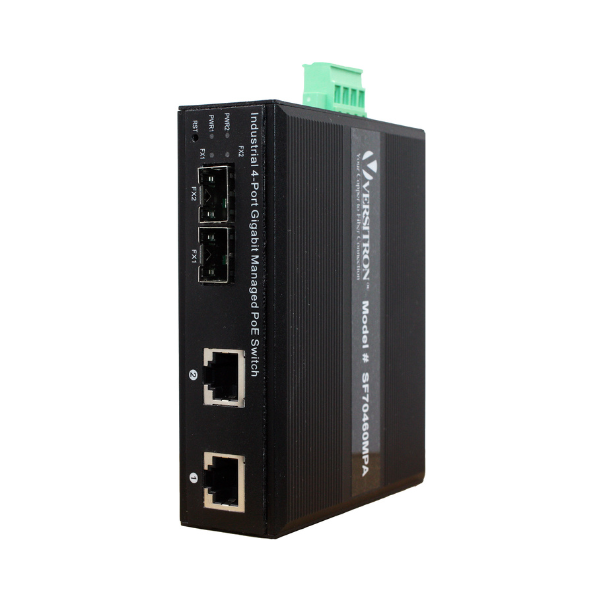
4-Port Managed Industrial PoE+ Switch | 2-RJ45 Ethernet Ports, 2-SFP Fiber Ports
View Details -
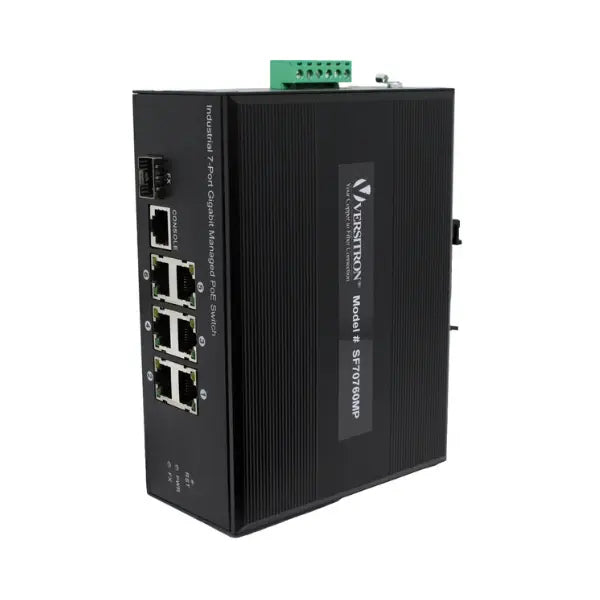
7-Port Managed Industrial PoE+ Switch | 6-RJ45 Ethernet Ports, 1-SFP Fiber Port
View Details -

10-Port Managed PoE Switch | 8-RJ45 Ethernet Ports, 2-SFP Ports
View Details -
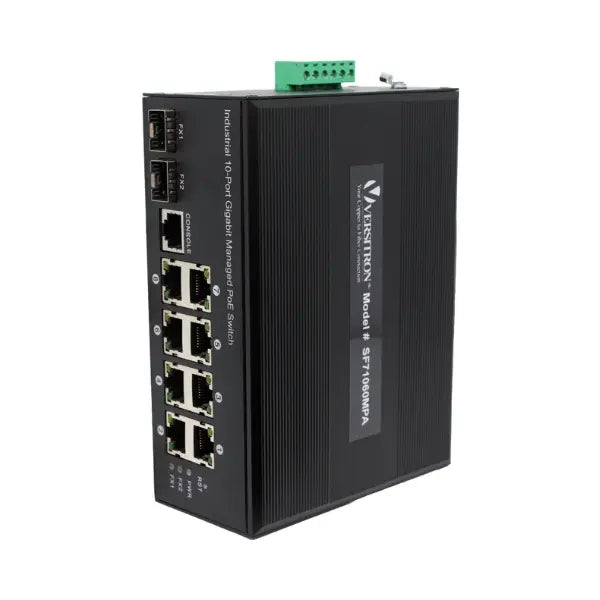
10-Port Managed Industrial PoE+ Switch | 8-RJ45 Ethernet Ports, 2-SFP Fiber Ports
View Details -

20-Port Managed PoE+ Switch | 16-RJ45 Ethernet Ports, 4-SFP Fiber Ports
View Details -

28-Port Managed PoE+ Switch | 24-RJ45 Ethernet Ports, 4-SFP Fiber Ports
View Details -
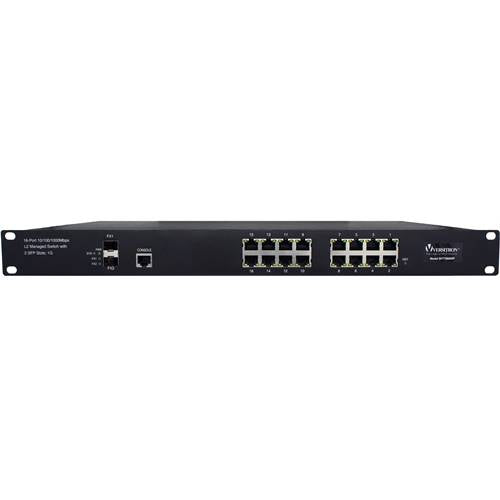
18-Port Managed Industrial PoE Switch | 16-RJ45 Ethernet Ports, 2-SFP Fiber Ports
View Details -

52-Port Managed PoE+ Switch | 48-RJ45 Ethernet Ports, 4-SFP Fiber Ports
View Details


