 1-800-537-2296
 sales@versitron.com



Top Applications of 4 Channel Video to Fiber Installation Kits in Commercial and Military Security
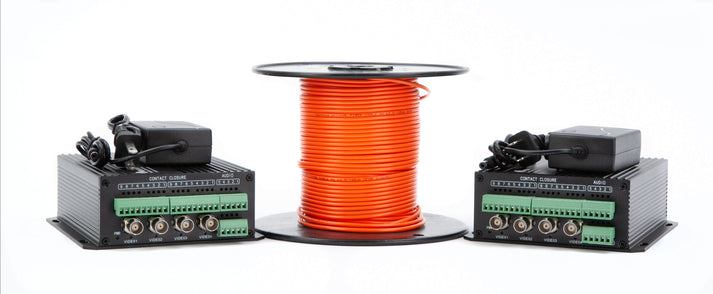
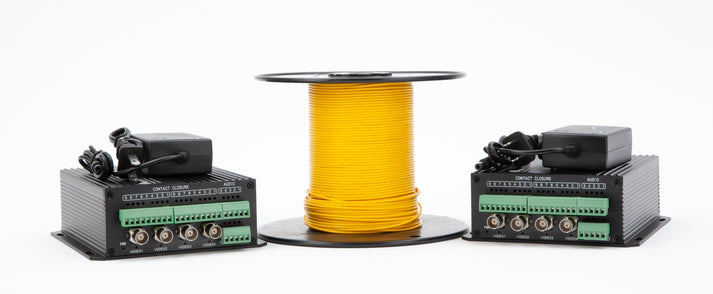
4-Channel Video to Fiber Installation Kits
Surveillance systems often require multiple cameras to monitor a single remote location. A building entrance may need cameras covering several approaches, an intersection may require multiple viewing angles, or an industrial facility may have a group of cameras located far from its central security office.

When four analog video signals must travel between the same two locations, a 4-channel video-to-fiber installation kit provides an efficient alternative to running separate long-distance copper connections for each camera.
These systems convert multiple video signals for transmission over fiber optic cable, allowing organizations to extend surveillance connections over greater distances while gaining the advantages of fiber, including immunity to electromagnetic interference (EMI) and radio-frequency interference (RFI).
Available configurations can also support additional communication requirements such as data and audio, making 4-channel systems a flexible option for commercial, government, transportation, industrial, and other surveillance applications.
What Is a 4-Channel Video-to-Fiber Installation Kit?
A 4-channel video-to-fiber installation kit is designed to transport up to four compatible analog video signals between two locations using fiber optic cable.
A typical system includes a transmitter at the camera location and a corresponding receiver at the centralized monitoring or recording location.
The basic process is straightforward:
- Up to four analog video signals connect to the transmitter.
- The transmitter converts the incoming signals for optical transmission.
- The signals travel across the fiber optic link.
- The receiver converts the optical transmission back into compatible video signals.
- The video outputs connect to appropriate monitoring, switching, or recording equipment.
Depending on the selected configuration, the system may also support data or audio transmission.
This architecture is particularly useful when several cameras are concentrated in the same remote surveillance zone and need to communicate with equipment located elsewhere.
Explore Our 4-Channel Video to Fiber Installation Kits



Why Choose a 4-Channel System?
The primary reason to select a 4-channel video-to-fiber solution is infrastructure efficiency.
Consider a facility with four analog cameras installed at a remote entrance, parking area, perimeter location, or separate building. Each camera must send video back to a central security location.
Instead of treating each camera as a completely independent long-distance transmission link, a 4-channel system allows the group of video signals to be transported through a common fiber transmission solution.
This approach can provide several practical advantages:
- Support for multiple cameras between common locations
- Reduced dependence on long copper video cable runs
- Simplified infrastructure for remote surveillance zones
- Centralized monitoring of geographically distributed cameras
- Options for integrating compatible data and audio signals
- Single-mode and multimode fiber configurations
The 4-channel architecture is particularly well suited to installations where camera locations naturally occur in groups.
Rather than simply asking how many cameras exist throughout the entire surveillance system, system designers should consider how many video signals need to travel between each pair of locations.
In many applications, four channels provide a useful balance between capacity and deployment flexibility.
Why Use Fiber for Multi-Camera Video Transmission?
Fiber optic transmission provides several advantages when surveillance signals must travel over significant distances or through challenging environments.
Long-Distance ConnectivityCopper-based video transmission becomes increasingly challenging as transmission distances grow.
Fiber allows surveillance signals to travel across significantly greater distances, depending on the selected equipment and fiber type.
This makes video-to-fiber transmission useful for connecting cameras located across:
- Large commercial properties
- Government campuses
- Transportation facilities
- Industrial sites
- Utility infrastructure
- Remote buildings
- Parking facilities
- Perimeter security areas
A group of four remote cameras can transmit video back to a centralized monitoring facility without requiring individual long-distance copper runs for each camera.
Immunity to Electromagnetic InterferenceFiber optic cable carries information using light and is therefore immune to electromagnetic and radio-frequency interference.
This can be particularly important in environments containing:
- Motors
- Generators
- Transformers
- High-voltage equipment
- Industrial machinery
- Radio transmission equipment
Where electrical interference may affect copper communication cabling, fiber provides a transmission medium unaffected by EMI and RFI.
Electrical IsolationFiber does not conduct electricity between connected locations.
This provides electrical isolation that can be valuable when cameras and monitoring equipment are installed in separate buildings or across geographically distributed facilities.
It also prevents electrical disturbances from traveling directly through the fiber communication cable between locations.
Consistent Signal TransmissionLong copper transmission paths can introduce signal attenuation and interference.
A properly designed video-to-fiber system provides an optical transmission path between the camera location and centralized surveillance equipment, helping maintain consistent video transmission across the supported distance of the equipment.
Understanding the Available 4-Channel Configurations
Different surveillance applications require different combinations of signals.
Some installations need only video. Others require data communication for camera control, while more specialized systems may also require audio or contact-closure capabilities.
The available 4-channel configurations described for these systems include:
- Video-only configurations
- Video-and-data configurations
- Video, data, audio, and contact-closure configurations
- Single-mode fiber options
- Multimode fiber options
Selecting the appropriate configuration begins with identifying exactly what must be communicated between the remote and central locations.
Video-Only 4-Channel Systems
A video-only system is appropriate when four compatible cameras need to send video to centralized surveillance equipment without requiring additional control or communication channels through the fiber system.
Potential applications include:
- Fixed-camera surveillance
- Building perimeter monitoring
- Parking facilities
- Commercial properties
- Industrial sites
- Remote facility monitoring
For straightforward surveillance applications, a video-only configuration provides the simplest approach.
Video-and-Data Configurations
Some camera systems require a data path in addition to video transmission.
Pan-Tilt-Zoom cameras, for example, may use compatible serial data communications to receive control commands from operators or surveillance management equipment.
A video-and-data configuration can provide transmission for the four video signals while also supporting compatible data communication.
This can be useful when remote surveillance zones include controllable cameras or other equipment requiring a supported data interface.
Before selecting a system, installers should verify:
- Required data protocol
- Direction of data communication
- Camera-control requirements
- Compatibility with the selected transmitter and receiver
This is particularly important because not every camera-control system uses the same data interface.
Video, Data, Audio, and Contact-Closure Applications
Some surveillance and security systems require more than video and camera-control data.
Available configurations may also support audio and contact-closure communications, allowing additional signals to be transported as part of the overall fiber transmission system.
These capabilities may be useful for applications involving:
- Controlled entrances
- Remote security stations
- Gates and access points
- Intercom-related infrastructure
- Alarm or sensor signaling
- Security operations requiring multiple signal types
Contact closures can provide a simple method of communicating the state of compatible external devices, while audio channels can support applications requiring audio transmission between locations.
The specific interface requirements should always be verified before selecting the system.
Single-Mode vs. Multimode Fiber
The appropriate fiber type depends primarily on transmission distance and existing infrastructure.
Multimode FiberMultimode fiber is commonly used for shorter links within facilities, buildings, and campuses.
It may be appropriate when:
- Multimode fiber is already installed
- Transmission distances are relatively short
- Cameras and monitoring equipment are located within the same facility or campus
Typical applications may include commercial properties, manufacturing facilities, educational campuses, and multi-building surveillance systems.
Single-Mode FiberSingle-mode fiber is generally selected when significantly longer transmission distances are required.
Potential applications include:
- Large government campuses
- Transportation infrastructure
- Utility facilities
- Industrial sites
- Remote perimeter surveillance
- Geographically distributed security networks
The selected transmitter and receiver must match the fiber type used in the installation.
Fiber connector requirements and the supported transmission distance should also be verified as part of the system design.
Commercial Security Applications
Commercial properties frequently have groups of cameras concentrated around specific areas, making them natural candidates for 4-channel video transmission.
For example, a remote building might have cameras monitoring:
- The primary entrance
- A loading area
- A parking lot
- The building perimeter
A 4-channel video-to-fiber system can transport these camera feeds back to a centralized security facility over fiber.
Potential commercial applications include:
- Corporate campuses
- Warehouses
- Distribution centers
- Shopping centers
- Office complexes
- Hotels and resorts
- Large retail properties
- Multi-building facilities
This approach allows organizations to centralize surveillance monitoring while extending camera coverage across larger properties.
Government and Defense Facility Surveillance
Government and defense facilities may require surveillance across multiple buildings, secure areas, entrances, and perimeter locations.
Where compatible analog camera systems are used, 4-channel video-to-fiber systems can provide a practical way to connect groups of remote cameras to centralized surveillance infrastructure.
Potential applications include:
- Government campuses
- Administrative facilities
- Military installations
- Security checkpoints
- Perimeter monitoring
- Storage and logistics facilities
- Remote facility surveillance
Fiber can be particularly useful when camera locations are separated by long distances or when transmission paths pass through electrically noisy environments.
It is important, however, to distinguish the advantages of fiber transmission from cybersecurity functions. Fiber provides EMI/RFI immunity and electrical isolation, but the transmission equipment should not be described as providing encryption unless encryption is an explicitly supported feature.
Similarly, equipment used within a military facility should not automatically be characterized as "military-grade" unless it has the appropriate environmental specifications or qualifications.
The practical value of a 4-channel fiber system in these environments is its ability to provide reliable, long-distance connectivity for multiple compatible video signals within a centralized surveillance architecture.
Transportation and Traffic Monitoring Applications
Transportation systems often require multiple cameras at a single remote location. An intersection, railway facility, toll area, or transportation terminal may have several cameras monitoring different directions and operational areas.
A 4-channel video-to-fiber system can provide an efficient way to transport these video signals back to centralized monitoring equipment.
Potential applications include:
- Traffic monitoring systems
- Highway surveillance
- Railway facilities
- Airports
- Ports and terminals
- Toll facilities
- Parking infrastructure
- Public transit facilities
For example, four cameras installed around a remote intersection could connect to a local fiber transmitter, allowing the video signals to travel over fiber to a receiver at a traffic management or surveillance center.
Where compatible PTZ cameras are deployed, a video-and-data configuration may also provide the required control path between the cameras and centralized equipment.
Fiber's immunity to electromagnetic and radio-frequency interference can be particularly valuable in transportation environments containing electrical equipment, signaling infrastructure, and other potential sources of interference.
Industrial and Utility Surveillance
Industrial facilities and utility infrastructure frequently combine large physical footprints with challenging operating environments.
Cameras may be installed near manufacturing equipment, electrical systems, remote buildings, or perimeter locations far from the primary security facility.
Potential applications for 4-channel video-to-fiber systems include:
- Manufacturing facilities
- Utility substations
- Power generation facilities
- Water and wastewater treatment plants
- Oil and gas facilities
- Warehouses and distribution centers
- Renewable energy installations
- Industrial perimeter surveillance
When four cameras are concentrated in one area, a multi-channel fiber transmission system can provide a practical connection back to centralized monitoring equipment.
Fiber also provides an important transmission advantage in environments containing significant electromagnetic interference. Because information travels optically rather than electrically, the communication link itself is unaffected by EMI and RFI.
The specific environmental requirements of the installation should still be considered when selecting equipment. If transmitters or receivers will be exposed to extreme temperatures, moisture, dust, vibration, or other harsh conditions, the environmental ratings of the selected equipment and enclosure should be verified.
PTZ Camera and Control Applications
Some surveillance systems require operators to control cameras located at remote sites.
Pan-Tilt-Zoom cameras may use a compatible serial data interface to receive commands for camera movement and zoom functions.
For these applications, a 4-channel video-and-data fiber system can provide both video transmission and a data communication path.
A typical architecture may include:
At the remote surveillance location:
- Up to four compatible analog cameras
- PTZ cameras where required
- 4-channel video-to-fiber transmitter
Across the transmission link:
- Single-mode or multimode fiber optic cable
At the centralized location:
- Corresponding fiber receiver
- DVR, matrix switch, monitor, or other compatible video equipment
- PTZ controller or surveillance control system
Before selecting equipment, system designers should verify the required data interface and communication direction.
The presence of a data channel does not automatically guarantee compatibility with every PTZ system, so matching the transmission equipment to the camera-control requirements is essential.
Access Control and Contact-Closure Applications
Configurations supporting contact closures can provide additional flexibility in security applications where simple status or control signals must travel between remote and centralized locations.
Potential uses may include compatible:
- Gate systems
- Door status monitoring
- Alarm contacts
- Security sensors
- Access-control equipment
- Remote signaling devices
A surveillance location, for example, might include four cameras, a controlled gate, and an alarm sensor. A system supporting video, data, audio, and contact closures may allow several of these communication requirements to share the same overall fiber transmission architecture.
The exact capabilities depend on the selected equipment, so the number and type of supported interfaces should be verified before system design.
Centralized Surveillance Architecture
One of the strongest use cases for multi-channel video-to-fiber transmission is centralized surveillance.
Large organizations often operate cameras across multiple buildings or remote areas while maintaining a central security operations center.
A typical deployment might look like this:
Remote Location A: Four cameras monitoring a building and surrounding area.
Remote Location B: Four cameras monitoring a parking facility.
Remote Location C: Four cameras monitoring an entrance or perimeter zone.
Each remote location can use an appropriate 4-channel transmitter, with fiber connections carrying the video signals back toward centralized receiving equipment.
This architecture allows surveillance coverage to expand geographically while maintaining centralized monitoring and recording.
Depending on the available equipment, receiving units may be deployed individually or incorporated into a rack-based installation for more organized equipment management.
When Does a 4-Channel System Make Sense?
A 4-channel system is not automatically the best choice simply because a surveillance network contains four or more cameras.
The key consideration is where the cameras are located and where their signals need to go.
A 4-channel architecture is particularly useful when:
- Four cameras are concentrated at one remote location
- The cameras share a common destination
- Fiber is available between the two locations
- Long-distance copper transmission is undesirable
- The installation requires centralized surveillance
- Additional data, audio, or contact-closure functions are needed
If four cameras are located in completely different areas with separate fiber paths, individual transmission systems may make more sense.
Conversely, if eight or more cameras are concentrated at one location, a higher-channel-count system may provide a more efficient architecture.
The correct approach depends on the physical layout of the surveillance network rather than the total number of cameras alone.
How to Choose the Right 4-Channel Video-to-Fiber Kit
Several factors should be evaluated before selecting a system.
| Requirement | Recommended Consideration |
|---|---|
| Four fixed analog cameras | Video-only configuration |
| PTZ or compatible remote camera control | Video-and-data configuration |
| Additional audio or signaling requirements | Select a configuration supporting the required interfaces |
| Existing multimode fiber | Choose compatible multimode equipment |
| Long-distance transmission | Consider an appropriate single-mode configuration |
| Multiple signals between common locations | 4-channel architecture may simplify deployment |
| Centralized receiving location | Consider equipment organization and rack-mount options |
| Harsh installation environment | Verify actual environmental specifications |
System designers should also confirm:
- Supported video formats
- Maximum transmission distance
- Fiber type
- Fiber connector type
- Number of required fiber strands
- Data interface compatibility
- Audio requirements, if applicable
- Contact-closure requirements, if applicable
- Local power availability
- Equipment mounting requirements
This specification process is especially important for systems carrying several different signal types.
Installation Considerations
Proper installation and system planning are essential for reliable video-over-fiber transmission.
Match the Fiber TypeThe transmitter, receiver, and installed fiber must be compatible.
Single-mode and multimode equipment should be selected according to the fiber infrastructure and required transmission distance.
Verify the Optical Link DistanceThe selected equipment should support the actual fiber distance between locations.
Connectors, splices, and other components in the optical path should also be considered when evaluating the overall link.
Confirm Video CompatibilityVerify that the cameras and receiving equipment use video formats supported by the selected fiber transmission system.
Verify Data and Audio InterfacesIf the installation requires PTZ control, audio, or other communications, confirm compatibility before installation.
Plan for PowerTransmitters and receivers require appropriate power at their respective locations. Power availability should be incorporated into the system design.
Protect Fiber ConnectionsClean fiber connectors and proper installation practices help minimize optical loss and maintain reliable system performance.
Extending Existing Surveillance Systems with Fiber
A major advantage of video-to-fiber transmission is the ability to extend existing surveillance infrastructure without necessarily replacing every camera or recording device.
Organizations may introduce fiber when:
- Surveillance expands to a new building
- Remote cameras are added to a perimeter
- A parking or entrance area requires additional coverage
- Existing copper transmission distances become impractical
- Fiber infrastructure already exists between facilities
- Electrical interference affects existing communication paths
In these situations, a 4-channel system can provide an effective bridge between a group of compatible analog cameras and centralized surveillance equipment.
This allows organizations to modernize the transmission portion of the system while continuing to use compatible existing surveillance equipment.
Why Choose VERSITRON 4-Channel Video-to-Fiber Solutions?
VERSITRON offers 4-channel video-to-fiber solutions in multiple configurations to support different surveillance and communication requirements.
Available options include configurations supporting:
- Four analog video channels
- Video-only transmission
- Video and data transmission
- Video, data, audio, and contact closures
- Single-mode fiber
- Multimode fiber
- Long-distance fiber transmission
This flexibility allows system integrators and security professionals to select equipment based on the specific signals that must travel between locations.
Rather than installing unnecessary functionality, organizations can choose a configuration that matches the video, control, audio, and signaling requirements of the application.
Conclusion
Four-channel video-to-fiber installation kits provide an efficient solution when multiple analog cameras located in the same surveillance zone need to communicate with centralized monitoring equipment.
By transporting video over fiber, these systems can overcome many of the distance and interference limitations associated with extended copper transmission while providing electrical isolation between connected locations.
Different configurations also allow the fiber transmission system to support more than video alone. Depending on the selected equipment, data, audio, and contact-closure capabilities can accommodate PTZ control and other security-system communication requirements.
The greatest advantage of a 4-channel architecture is its ability to consolidate several camera signals between common locations. This makes it particularly useful for remote buildings, entrances, transportation facilities, industrial sites, government campuses, and other environments where cameras are deployed in groups.
The key to a successful installation is selecting the correct system based on video requirements, channel count, fiber type, transmission distance, data interfaces, additional communication requirements, and the physical layout of the surveillance network.
When properly specified, a 4-channel video-to-fiber installation kit provides a practical and scalable way to extend existing surveillance infrastructure across fiber optic networks.


