 1-800-537-2296
 sales@versitron.com



Video Distribution Amplifiers for Surveillance, Control Rooms, and Professional Video Systems
Video Distribution Amplifiers
Video systems often need to send the same source signal to more than one destination.
A surveillance camera feed may need to appear on multiple monitors. A control room may need to route the same video source to monitoring, recording, and switching equipment. A professional video facility may need several independent outputs from a single source without relying on passive signal splitting.

Video distribution amplifiers are designed for these applications.
A video distribution amplifier accepts one or more compatible video inputs and provides multiple driven outputs, allowing the same source signal to be delivered to several destinations while maintaining the appropriate signal characteristics for the supported video format.
Depending on the model and video technology, distribution amplifiers can be used in:
- Surveillance systems
- Security control rooms
- Operations centers
- Broadcast environments
- Professional video systems
- Transportation monitoring facilities
- Government installations
- Commercial facilities
- Multi-monitor video systems
The key to selecting the correct distribution amplifier is matching the equipment to the video signal format, number of sources, required number of outputs, cabling infrastructure, and overall system architecture.
What Is a Video Distribution Amplifier?
A video distribution amplifier, commonly called a VDA, is an active device designed to distribute a video signal to multiple destinations.
A simple architecture might look like this:
Video Source → Distribution Amplifier → Multiple Video Outputs
Those outputs can then connect to compatible equipment such as:
- Video monitors
- Recording equipment
- Video switchers
- Control-room displays
- Other compatible video devices
Unlike a passive splitter, a distribution amplifier actively provides separate outputs designed to maintain the required signal level and impedance characteristics for the supported video format.
This is particularly important when a single source must feed several destinations.
Explore Our Video Distribution Amplifiers

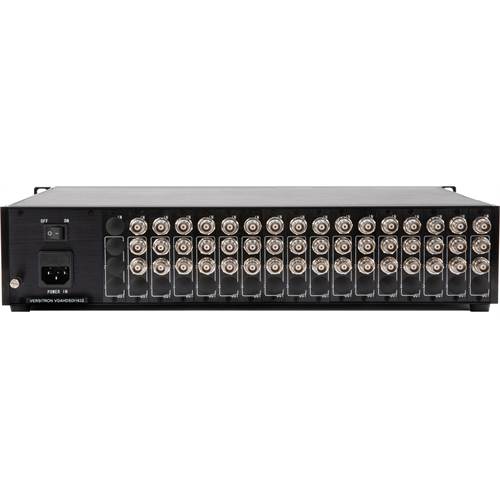


Video Distribution Amplifier vs. Passive Video Splitter
It may seem simple to divide a video signal using passive connectors or splitters, but doing so can affect signal integrity.
Video systems are designed around specific electrical characteristics, including impedance and signal levels.
When a signal is improperly divided among multiple destinations, the result may include:
- Reduced signal level
- Improper termination
- Image degradation
- Unstable video
- Other signal-integrity problems
An active video distribution amplifier is designed specifically to create multiple usable outputs from the incoming source.
A typical application might be:
Camera Feed → Distribution Amplifier
with separate outputs going to:
Output 1 → Primary Monitor
Output 2 → Recording Equipment
Output 3 → Secondary Monitoring Station
Output 4 → Additional Compatible Equipment
This allows the same source to serve several destinations without relying on improper passive signal splitting.
What Does a 16-Input Video Distribution Amplifier Do?
Higher-density distribution amplifiers can support multiple independent video sources within the same chassis.
The Versitron product family referenced in the original article includes configurations with 16 video inputs and multiple output capacities, including 32, 48, and 64 outputs.
These configurations can support different distribution requirements.
For example, a 16-input, 32-output configuration provides an average of two outputs for each input when configured accordingly.
A simplified architecture might look like:
16 Video Inputs → Distribution Amplifier → 32 Video Outputs
A higher-output system may provide additional copies of each incoming video signal.
For example:
16 Video Inputs → Distribution Amplifier → 64 Video Outputs
This type of architecture can be useful in larger monitoring environments where the same video sources need to reach several different destinations.
The exact input-to-output distribution and configuration should always be verified for the specific product model.
Understanding Input and Output Requirements
Choosing a distribution amplifier begins with two basic questions:
How many independent video sources need to be connected?
and
How many destinations need to receive each source?
These are different requirements.
Consider a security operations center with 16 incoming video feeds.
If every source needs to reach only one monitor, a distribution amplifier may not be necessary.
If each source must simultaneously feed a monitoring display and a separate recording or processing system, additional outputs are required.
For example:
Video Source 1 → Monitor + Recording Equipment
Video Source 2 → Monitor + Recording Equipment
Video Source 3 → Monitor + Recording Equipment
and so on.
A higher-output distribution amplifier can support architectures where each source must be delivered to even more destinations.
The correct product should therefore be selected according to the actual number of video inputs and required outputs rather than simply choosing the model with the greatest capacity.
Video Distribution in Surveillance Systems
Video distribution amplifiers can be useful in surveillance systems that use compatible baseband video signals.
Potential applications include:
- Security control rooms
- Central monitoring facilities
- Industrial surveillance
- Transportation monitoring
- Government facilities
- Perimeter security systems
- Commercial security operations
For example, a camera feed may need to be viewed at a primary security station while also being delivered to separate recording or monitoring equipment.
A distribution amplifier provides the additional outputs required to support that architecture.
It is important, however, to distinguish baseband video distribution from IP surveillance.
A conventional video distribution amplifier does not distribute Ethernet network traffic from IP cameras.
Video Distribution Amplifiers vs. IP Video Networks
IP cameras generate network traffic and communicate through Ethernet infrastructure.
A typical IP surveillance architecture might look like:
IP Cameras → Ethernet or PoE Switch → Network → NVR or Video Management System
Video streams can then be accessed by authorized network devices according to the design of the IP surveillance system.
A conventional baseband video distribution amplifier serves a different purpose.
Its architecture may look like:
Compatible Video Source → Video Distribution Amplifier → Multiple Physical Video Outputs
The two technologies should not be treated as interchangeable.
If an application uses IP cameras, network switches and related Ethernet infrastructure are generally responsible for transporting the video data.
If an application uses compatible baseband video signals that must be physically distributed to several destinations, a video distribution amplifier may be appropriate.
Analog and HD Video Distribution
Different video technologies require compatible distribution equipment.
A distribution amplifier designed for one signal format should not automatically be assumed to support every other type of video.
Depending on the specific Versitron model, the product line includes analog/HD interface distribution equipment as well as dedicated HD-SDI distribution equipment.
Before selecting a distribution amplifier, verify:
- Video signal format
- Supported resolution
- Input interface
- Output interface
- Required number of inputs
- Required number of outputs
- Cabling requirements
Compatibility should be determined from the specifications of the individual product rather than from the general term "video distribution amplifier."
HD-SDI Video Distribution Amplifiers
HD-SDI is a serial digital video interface used in professional video, broadcast, monitoring, and certain surveillance applications.
An HD-SDI distribution amplifier accepts a compatible HD-SDI signal and creates multiple outputs for connection to other compatible HD-SDI equipment.
A typical application might look like:
HD-SDI Source → HD-SDI Distribution Amplifier → Multiple HD-SDI Destinations
Potential destinations may include:
- Professional monitors
- Recording equipment
- Video switchers
- Routing equipment
- Other compatible SDI devices
Because SDI signals have specific data rates and technical requirements, the distribution amplifier must support the applicable SDI format.
The supported video standards and resolutions should always be verified for the selected model.
Video Distribution for Security Control Rooms
Security control rooms often bring together video from many sources and deliver those signals to multiple pieces of equipment.
Depending on the system architecture, video may need to reach:
- Operator monitors
- Recording systems
- Video switching equipment
- Secondary monitoring positions
- Other processing or display equipment
A distribution amplifier can provide additional physical outputs when the same compatible source signal must be available at more than one destination.
For example:
Video Source → Distribution Amplifier
Output 1 → Main Security Monitor
Output 2 → Recording Equipment
Output 3 → Secondary Operations Position
Output 4 → Additional Video Equipment
In higher-density systems, multi-input distribution amplifiers allow several source signals to be handled within a centralized chassis.
This can provide a more organized architecture than using numerous individual distribution devices.
Government and Public-Sector Applications
Government and public-sector facilities may use video distribution equipment in centralized monitoring and operations environments.
Potential applications include:
- Facility surveillance
- Security operations centers
- Transportation monitoring
- Public safety facilities
- Government campuses
- Infrastructure monitoring
The role of the distribution amplifier is the same regardless of the sector: to provide multiple outputs from compatible incoming video sources.
A product should not automatically be described as military-grade, secure, encrypted, or hardened simply because it is installed in a government or defense application.
Those characteristics must be supported by the actual product specifications.
Military and Defense Applications
Defense facilities may also operate centralized video monitoring systems where compatible video sources must be distributed to several destinations.
Potential applications may include:
- Base security monitoring
- Operations facilities
- Perimeter surveillance
- Training environments
- Other fixed video systems
The suitability of a particular distribution amplifier depends on the technical requirements of the installation.
Factors to evaluate include:
- Video format
- Number of inputs and outputs
- Installation environment
- Equipment mounting
- Power requirements
- Required video interfaces
If equipment must operate in extreme temperatures, high-vibration environments, vehicles, or field deployments, the environmental specifications should be verified independently.
A standard rack-mounted video distribution amplifier should not be presented as tactical or ruggedized equipment unless it was specifically designed and tested for those conditions.
Transportation Monitoring Applications
Transportation facilities can contain centralized operations centers where video from multiple locations is monitored simultaneously.
Potential environments include:
- Airports
- Railway facilities
- Transit systems
- Traffic operations centers
- Ports
- Parking facilities
Where compatible baseband video signals are used, distribution amplifiers can provide multiple outputs for monitoring, recording, switching, or other video equipment.
The distribution amplifier itself does not extend Ethernet networks or distribute IP camera traffic.
In hybrid facilities containing both baseband video and IP surveillance systems, the two architectures may operate alongside one another using different transmission and distribution equipment.
Commercial and Industrial Video Systems
Commercial and industrial facilities may also require video signals to be distributed among several destinations.
Potential applications include:
- Manufacturing facilities
- Warehouses
- Large commercial properties
- Corporate security centers
- Distribution facilities
- Building monitoring systems
For example, a compatible surveillance feed may need to appear at both a central security desk and a separate operations station.
A distribution amplifier can create the additional physical outputs required for the system.
The number of outputs should be selected according to actual requirements rather than simply installing the highest-capacity system available.
Professional AV and Broadcast Applications
Video distribution amplifiers are also widely applicable outside traditional surveillance.
Professional video systems often require a single source to feed multiple destinations simultaneously.
Potential applications include:
- Broadcast facilities
- Production environments
- Studios
- Control rooms
- Live event systems
- Post-production facilities
- Professional AV installations
For SDI-based systems, a compatible distribution amplifier can provide multiple outputs from a single source for monitoring, recording, switching, or other processing equipment.
This makes video distribution amplifiers useful anywhere a supported source signal must be replicated and delivered reliably to multiple destinations.
Video Distribution Amplifiers vs. Video Switchers
Video distribution amplifiers and video switchers perform different functions.
A distribution amplifier takes an incoming video signal and provides multiple copies of that signal at separate outputs.
A simplified architecture looks like:
One Video Source → Distribution Amplifier → Multiple Simultaneous Outputs
A video switcher, by comparison, allows users or systems to select which input is connected to a particular output.
For example:
Multiple Video Sources → Video Switcher → Selected Video Output
The distinction is important.
Use a distribution amplifier when the same video source must be available simultaneously at multiple destinations.
Use a switcher when the application requires selecting between different video sources.
In some larger systems, distribution amplifiers and switchers may be used together.
Distribution Amplifiers vs. Video Matrix Systems
A video matrix system provides more flexible routing than a conventional distribution amplifier.
A matrix allows multiple inputs to be independently routed to multiple outputs.
For example, a matrix might allow:
- Input 1 to appear on Outputs 1, 3, and 5
- Input 2 to appear on Outputs 2 and 4
- Input 3 to appear on Output 6
A distribution amplifier generally follows a more predetermined input-to-output architecture.
This makes distribution amplifiers well suited to applications where the primary requirement is creating multiple outputs from the same source signals.
A matrix may be more appropriate when operators need to dynamically route different sources to different destinations.
Understanding the required signal flow before selecting equipment can prevent unnecessary complexity and expense.
Using Video Distribution Amplifiers with Video-over-Fiber Systems
Video distribution amplifiers and video-over-fiber equipment can serve complementary roles within the same system.
The distribution amplifier itself does not convert an electrical video signal to an optical signal.
However, a compatible fiber optic transmitter and receiver can provide the long-distance transmission path between locations.
For example, an architecture might include:
Video Source → Distribution Amplifier → Fiber Transmitter → Fiber → Fiber Receiver → Remote Video Equipment
Alternatively, fiber may bring a video signal into a central facility before it is distributed:
Remote Video Source → Fiber Transmitter → Fiber → Fiber Receiver → Distribution Amplifier → Multiple Local Destinations
The correct architecture depends on where the video needs to be transmitted and where multiple outputs are required.
This distinction is important because a video distribution amplifier should not be described as a fiber optic video converter unless the specific product actually contains optical interfaces.
Centralized Video Distribution Architectures
Higher-density distribution amplifiers are particularly useful in centralized equipment rooms and control facilities.
A system with multiple incoming video sources may require each source to reach several destinations.
For example:
16 Incoming Video Sources
↓
16-Input Distribution Amplifier
↓
Multiple Outputs per Source
↓
Monitoring + Recording + Switching or Other Compatible Equipment
This type of architecture can consolidate video distribution into a centralized chassis rather than using numerous individual distribution devices.
Potential advantages may include:
- More organized equipment installation
- Centralized signal distribution
- Easier cable identification
- Reduced equipment clutter
- Simplified system documentation
The exact advantages depend on the configuration of the equipment and overall system design.
Understanding 16×32, 16×48, and 16×64 Configurations
The Versitron product family referenced in the original article includes 16-input distribution amplifiers with 32, 48, and 64 outputs.
At a high level, these configurations represent different output densities.
A 16-input, 32-output system may be appropriate when each source needs a relatively small number of additional destinations.
A 16-input, 48-output system provides greater distribution capacity.
A 16-input, 64-output system supports applications requiring an even greater number of physical video outputs.
However, system designers should verify the exact input-to-output configuration of each model rather than assuming that the total output count can be assigned arbitrarily.
The right configuration depends on how many destinations need to receive each source.
How Many Outputs Do You Actually Need?
Before selecting a distribution amplifier, map the required signal path for every video source.
For each input, determine whether the signal needs to reach:
- One or more monitors
- Recording equipment
- Switching equipment
- Processing equipment
- A remote transmission system
- Another compatible destination
For example, if a source needs to reach a primary monitor, a secondary monitor, a recorder, and a separate video processing system, four independent outputs may be required.
Another source in the same system may require only two outputs.
Understanding these requirements before selecting equipment helps ensure that the distribution architecture provides sufficient capacity without unnecessary overbuilding.
Signal Integrity and Proper Termination
Video distribution systems depend on maintaining the electrical characteristics required by the video format.
Improper cabling or termination can affect signal quality even when a distribution amplifier is used.
Installation considerations may include:
- Correct cable impedance
- Proper connector installation
- Appropriate termination
- Cable quality
- Cable length
- Signal format
- Equipment compatibility
For many professional and surveillance video systems using BNC connections, 75-ohm coaxial infrastructure is commonly required.
However, the exact cabling requirements should always be verified for the selected equipment and video standard.
A distribution amplifier cannot compensate for every problem caused by damaged cables, incorrect impedance, poor connectors, or incompatible equipment.
Can a Distribution Amplifier Extend Video Distance?
A distribution amplifier should not automatically be treated as a long-distance video extender.
Its primary purpose is signal distribution.
Depending on the product and video format, the amplifier may regenerate, equalize, or reclock signals in ways that help maintain signal integrity. However, the supported cable distance depends on the specific equipment, video standard, cable type, and receiving equipment.
When video must travel significantly farther than the supported copper connection, a dedicated video-over-fiber system may be the more appropriate solution.
For example:
Video Source → Fiber Transmitter → Long-Distance Fiber Link → Fiber Receiver → Distribution Amplifier → Multiple Local Outputs
This architecture separates the two functions:
Fiber equipment handles long-distance transmission.
The distribution amplifier handles local signal distribution.
HD-SDI Signal Distribution and Reclocking
Digital SDI signals have different transmission characteristics from conventional analog video.
Depending on the specific HD-SDI distribution amplifier, signal processing may include functions such as:
- Signal amplification
- Equalization
- Reclocking
- Multiple regenerated outputs
Reclocking can help restore the timing characteristics of a compatible digital signal before it is distributed to multiple destinations.
However, these capabilities should only be attributed to models whose specifications explicitly support them.
The applicable SDI standards, data rates, resolutions, and supported cable distances should also be verified before system design.
Rack-Mounted Video Distribution Systems
Higher-density distribution amplifiers are often well suited to centralized rack installations.
Rack-based systems can provide an organized location for:
- Video distribution equipment
- Recording systems
- Video switching equipment
- Fiber transmission equipment
- Monitoring infrastructure
- Other associated video components
Good rack design should consider more than simply fitting the equipment into the available space.
System planners should also consider:
- Cable routing
- Equipment ventilation
- Power distribution
- Service access
- Connector accessibility
- Cable labeling
- Future expansion
For systems containing dozens of video connections, careful cable management can significantly simplify maintenance and troubleshooting.
Installation and Cable Management Best Practices
High-density video distribution systems can quickly become difficult to manage if connections are not clearly documented.
Recommended practices include:
- Labeling every video input
- Labeling every video output
- Documenting which outputs correspond to each source
- Using consistent camera or source identification
- Maintaining accurate system diagrams
- Organizing cables within equipment racks
- Providing appropriate strain relief
- Using the correct cable and connector type
For example, rather than labeling an input simply as "Camera 1," a facility might use a more descriptive identifier such as:
BLDG-A-ENTRANCE-01
The corresponding outputs can then be documented according to their destinations.
Good documentation becomes especially valuable when systems are expanded or serviced years after the original installation.
Designing for Future Expansion
Video systems can change over time.
Additional monitors may be added. Recording equipment may be replaced. New monitoring positions may be created.
When selecting a distribution amplifier, it can therefore be useful to consider reasonable future output requirements.
However, purchasing significantly more capacity than the system is likely to use may add unnecessary cost and complexity.
The goal should be to provide enough expansion capability for foreseeable requirements without dramatically overbuilding the system.
For larger facilities, modular or multiple distribution systems may also provide a practical approach to future expansion.
Common Mistakes When Selecting a Video Distribution Amplifier
Several common mistakes can lead to compatibility problems or an inefficient system design.
Confusing Video Distribution with IP NetworkingA conventional video distribution amplifier does not distribute Ethernet traffic from IP cameras.
IP surveillance systems typically use network switches and other Ethernet infrastructure.
Assuming Every Video Format Is SupportedAnalog video, AHD, HD-CVI, HD-TVI, and HD-SDI have different technical characteristics.
Verify the exact formats supported by the selected product.
Confusing a Distribution Amplifier with a SwitcherA distribution amplifier creates additional outputs from source signals.
A switcher selects which source is sent to an output.
Confusing a Distribution Amplifier with a MatrixA matrix provides flexible input-to-output routing.
A distribution amplifier generally provides a more predetermined distribution architecture.
Treating the Amplifier as a Fiber ConverterUnless the product includes optical interfaces, separate fiber transmission equipment is required to carry video over fiber.
Assuming the Amplifier Provides Unlimited Transmission DistanceMaximum cable distance depends on the video format, equipment, and cabling.
Ignoring Impedance and TerminationIncorrect cabling or termination can cause video quality problems even when the distribution equipment is operating properly.
Assuming Every Product Is RuggedizedEnvironmental suitability should be determined from the specifications of the individual product.
A Practical Video Distribution Amplifier Selection Checklist
Before selecting a video distribution amplifier, answer the following questions:
What video format is being distributed?Verify that the amplifier supports the source signal.
How many independent video sources are there?Determine the required number of inputs.
How many destinations need each source?Calculate the required number of outputs.
Do the outputs need to be available simultaneously?If not, a switcher or matrix system may be more appropriate.
What equipment will receive the outputs?Confirm compatibility with monitors, recorders, switchers, and other destination equipment.
What cable type is being used?Verify impedance, connector type, and supported transmission distance.
Is long-distance transmission required?Determine whether separate video-over-fiber equipment is needed.
Where will the amplifier be installed?Evaluate rack space, power, ventilation, and environmental conditions.
Is future expansion expected?Allow reasonable capacity for additional destinations where appropriate.
Choosing the Right Video Distribution Architecture
The best distribution system begins with understanding the required signal flow.
If one source must appear simultaneously on several monitors or devices, a distribution amplifier may provide the appropriate solution.
If operators need to select between multiple sources, a video switcher may be required.
If many sources must be dynamically routed to many destinations, a matrix architecture may be more suitable.
If video must travel across long distances, video-over-fiber transmission equipment may be incorporated into the system.
In larger installations, several of these technologies may work together.
The goal is not to make one device perform every function.
Instead, each component should perform the role for which it was designed.
Conclusion
Video distribution amplifiers provide an important function in surveillance, security, control-room, broadcast, and professional video systems where compatible source signals must be delivered simultaneously to multiple destinations.
Higher-density systems can consolidate multiple video inputs and provide additional outputs for monitoring, recording, switching, processing, and other compatible equipment. The Versitron product family discussed in this article includes 16-input configurations with 32, 48, and 64 outputs, as well as dedicated HD-SDI distribution equipment for applicable digital video systems.
Selecting the correct distribution amplifier requires understanding the complete video architecture.
Video format, number of inputs, required outputs, cabling, signal distance, destination equipment, installation environment, and future expansion should all be considered before equipment selection.
It is equally important to distinguish a distribution amplifier from other video and networking technologies. A distribution amplifier is not an Ethernet switch, an IP video distributor, a fiber optic converter, or necessarily a long-distance extender.
Its primary purpose is straightforward but important: to take compatible video source signals and provide the additional properly driven outputs required by the system.
By matching the distribution equipment to the actual video technology and signal-flow requirements, system designers can build more organized, reliable, and scalable video infrastructures for surveillance, monitoring, control-room, and professional video applications.


